Follow us on:




Experience unparalleled legal expertise and personalized legal service at our distinguished law firm.



.jpeg)

.jpeg)
.jpeg)


.jpeg)






Our firm is a leading provider of comprehensive legal services, renowned for our commitment to excellence and client-centric approach. With a rich history of delivering outstanding results, we offer a diverse range of practice areas and industry expertise to meet the unique needs of our clients. Our firm prides itself on fostering long-term relationships built on trust, integrity, and a steadfast dedication to achieving favourable outcomes for our clients.

Lorem Ipsum is simply dummy text of the printing and typesetting industry. Lorem Ipsum has been the industry's standard dummy text ever since the 1500s, when an unknown printer took a galley of type and scrambled it to make a type specimen book. It has survived not only five centuries, but also the leap into electronic typesetting, remaining essentially unchanged. It was popularised in the 1960s with the release of Letraset sheets containing Lorem Ipsum passages, and more recently with desktop publishing software like Aldus PageMaker including versions of Lorem Ipsum.
Supreme Court

Lorem Ipsum is simply dummy text of the printing and typesetting industry. Lorem Ipsum has been the industry's standard dummy text ever since the 1500s, when an unknown printer took a galley of type and scrambled it to make a type specimen book. It has survived not only five centuries, but also the leap into electronic typesetting, remaining essentially unchanged. It was popularised in the 1960s with the release of Letraset sheets containing Lorem Ipsum passages, and more recently with desktop publishing software like Aldus PageMaker including versions of Lorem Ipsum.
High Court

Lorem Ipsum is simply dummy text of the printing and typesetting industry. Lorem Ipsum has been the industry's standard dummy text ever since the 1500s, when an unknown printer took a galley of type and scrambled it to make a type specimen book. It has survived not only five centuries, but also the leap into electronic typesetting, remaining essentially unchanged. It was popularised in the 1960s with the release of Letraset sheets containing Lorem Ipsum passages, and more recently with desktop publishing software like Aldus PageMaker including versions of Lorem Ipsum.
District Court

Lorem Ipsum is simply dummy text of the printing and typesetting industry. Lorem Ipsum has been the industry's standard dummy text ever since the 1500s, when an unknown printer took a galley of type and scrambled it to make a type specimen book. It has survived not only five centuries, but also the leap into electronic typesetting, remaining essentially unchanged. It was popularised in the 1960s with the release of Letraset sheets containing Lorem Ipsum passages, and more recently with desktop publishing software like Aldus PageMaker including versions of Lorem Ipsum.
Sub Division Court

Lorem Ipsum is simply dummy text of the printing and typesetting industry. Lorem Ipsum has been the industry's standard dummy text ever since the 1500s, when an unknown printer took a galley of type and scrambled it to make a type specimen book. It has survived not only five centuries, but also the leap into electronic typesetting, remaining essentially unchanged. It was popularised in the 1960s with the release of Letraset sheets containing Lorem Ipsum passages, and more recently with desktop publishing software like Aldus PageMaker including versions of Lorem Ipsum.
Consumer Commission

Lorem Ipsum is simply dummy text of the printing and typesetting industry. Lorem Ipsum has been the industry's standard dummy text ever since the 1500s, when an unknown printer took a galley of type and scrambled it to make a type specimen book. It has survived not only five centuries, but also the leap into electronic typesetting, remaining essentially unchanged. It was popularised in the 1960s with the release of Letraset sheets containing Lorem Ipsum passages, and more recently with desktop publishing software like Aldus PageMaker including versions of Lorem Ipsum.
Commercial Court

Lorem Ipsum is simply dummy text of the printing and typesetting industry. Lorem Ipsum has been the industry's standard dummy text ever since the 1500s, when an unknown printer took a galley of type and scrambled it to make a type specimen book. It has survived not only five centuries, but also the leap into electronic typesetting, remaining essentially unchanged. It was popularised in the 1960s with the release of Letraset sheets containing Lorem Ipsum passages, and more recently with desktop publishing software like Aldus PageMaker including versions of Lorem Ipsum.
CAT

Lorem Ipsum is simply dummy text of the printing and typesetting industry. Lorem Ipsum has been the industry's standard dummy text ever since the 1500s, when an unknown printer took a galley of type and scrambled it to make a type specimen book. It has survived not only five centuries, but also the leap into electronic typesetting, remaining essentially unchanged. It was popularised in the 1960s with the release of Letraset sheets containing Lorem Ipsum passages, and more recently with desktop publishing software like Aldus PageMaker including versions of Lorem Ipsum.
DRT

Lorem Ipsum is simply dummy text of the printing and typesetting industry. Lorem Ipsum has been the industry's standard dummy text ever since the 1500s, when an unknown printer took a galley of type and scrambled it to make a type specimen book. It has survived not only five centuries, but also the leap into electronic typesetting, remaining essentially unchanged. It was popularised in the 1960s with the release of Letraset sheets containing Lorem Ipsum passages, and more recently with desktop publishing software like Aldus PageMaker including versions of Lorem Ipsum.
Labour Commission

Lorem Ipsum is simply dummy text of the printing and typesetting industry. Lorem Ipsum has been the industry's standard dummy text ever since the 1500s, when an unknown printer took a galley of type and scrambled it to make a type specimen book. It has survived not only five centuries, but also the leap into electronic typesetting, remaining essentially unchanged. It was popularised in the 1960s with the release of Letraset sheets containing Lorem Ipsum passages, and more recently with desktop publishing software like Aldus PageMaker including versions of Lorem Ipsum.
RERA Tribunal

Lorem Ipsum is simply dummy text of the printing and typesetting industry. Lorem Ipsum has been the industry's standard dummy text ever since the 1500s, when an unknown printer took a galley of type and scrambled it to make a type specimen book. It has survived not only five centuries, but also the leap into electronic typesetting, remaining essentially unchanged. It was popularised in the 1960s with the release of Letraset sheets containing Lorem Ipsum passages, and more recently with desktop publishing software like Aldus PageMaker including versions of Lorem Ipsum.
SAT

Lorem Ipsum is simply dummy text of the printing and typesetting industry. Lorem Ipsum has been the industry's standard dummy text ever since the 1500s, when an unknown printer took a galley of type and scrambled it to make a type specimen book. It has survived not only five centuries, but also the leap into electronic typesetting, remaining essentially unchanged. It was popularised in the 1960s with the release of Letraset sheets containing Lorem Ipsum passages, and more recently with desktop publishing software like Aldus PageMaker including versions of Lorem Ipsum.
LRTT


Our team specializes in thorough property verification to safeguard your investments. We provide comprehensive checks to ensure the authenticity and legality of your property, giving you peace of mind in your real estate dealings.

For Canadians holding an Overseas Citizen of India (OCI) card who want to invest in Indian real estate without physically travelling to India, the question is common:👉 Can you buy property through a Power of Attorney (POA)?👉 What is the exact lawful process?👉 What are the required documents, legal risks, and government rules?This guide answers these questions in simple language — but with professional legal precision — so you and your family can make informed, compliant investment decisions in Indian property law.Can an OCI Card Holder Buy Property in India Without Coming to India?Yes — Generally, YesAs per Indian law under the Foreign Exchange Management Act (FEMA) and its Rules (especially Foreign Exchange Management (Non-Debt Instruments) Rules, 2019), an OCI card holder is legally allowed to:✅ Purchase residential & commercial property in India❌ Except agricultural land, plantation property, or farmhouses (unless inherited) Under FEMA Section 5 & Section 46, OCIs enjoy general permission to acquire immovable property without prior approval of the Reserve Bank of India (RBI), provided all payments are made through permissible banking channels. 📌 Important Legal Foundation📜 1. FEMA 1999 & Non-Debt Instruments RulesContains the core rules on foreign acquisition and transfer of immovable property.OCIs fall under the permitted class (similar to Non-Resident Indians (NRIs)).Purchase of residential or commercial property requires no RBI approval; agricultural-related property does. 📜 2. Transfer of Property Act, 1882Governs how property rights can be transferred through sale deeds, wills, or POA.Under Section 5 & Section 54 (Definitions) it recognises valid conveyance through registered instruments. 📜 3. Indian Registration Act, 1908All instruments dealing with immovable property (including sale deeds and POA) must be registered at the local Sub-Registrar’s office for legal effect.Notarised but unregistered POA is legally ineffective as a transfer instrument. Can a POA Be Used to Buy Property Without Physical Presence?Yes — But Only If Done Correctly.A Power of Attorney allows your appointed representative in India to act on your behalf for specific property dealings including:➡ Identifying property➡ Negotiating price➡ Signing the sale agreement➡ Executing the sale deed➡ Attending registration formalitiesBut there are legal requirements:1️⃣ Special/Specific Power of Attorney (SPA)a. Must be carefully drafted to clearly list powers — e.g., negotiation, signing agreements, registration, tax payments.b. A general POA is insufficient for property purchase. 2️⃣ Attestation/ApostilleIf executed outside India, the POA must be:a. Notarised in Canada (or local state)b. Then either:✔ Apostilled (if Canada is Hague member), or✔ Attested by the Indian Consulate/EmbassyThis ensures Indian authorities accept it as authentic. 3️⃣ Registration in IndiaThe POA must be:📍 Registered with the Sub-Registrar Office where the property is located📍 Paid applicable stamp duty (state-specific)Note: A notarised POA alone — without registration — is not legally effective to deal with property. 🧭 Step-by-Step Process to Buy Property via POA (Canadian OCI)This process helps you purchase legally and securely without traveling:🔎 Step 1: Identify the Propertya. Confirm seller’s titleb. Conduct title and encumbrance searchc. Ensure no litigation or fraud history‼ This is where legal due diligence done by an expert law firm like KHA Advocates protects you.🖋️ Step 2: Draft and Execute Power of AttorneyYour Canadian OCI must:✔ Choose the attorney (trustworthy person in India)✔ Draft a specific SPA✔ Notarise it in Canada (state)✔ Apostille/Consulate attestation✔ Ship properly sealed to India✔ Get it registered locally with stamp duty paid📌 POA must be time-bound, specific & covers registration authority.💸 Step 3: Arrange FEMA-Compliant PaymentPayment for property must follow FEMA guidelines:✅ Through inward remittanceOR✅ From your NRE, NRO, or FCNR(B) account❌ Cash/Foreign currency notes/Traveler’s cheques NOT ALLOWED. 📄 Step 4: Sale Agreement & RegistrationYour attorney will:1. Sign the Agreement to Sell2. Pay earnest deposit3. Prepare the Sale Deed4. Pay stamp duty & registration fees5. Register the sale deed at Sub-Registrar’s OfficeOnly a registered Sale Deed transfers ownership. — POA itself does not transfer rights legally. 🧾 Step 5: PAN & Tax ComplianceOCI must hold:✔ Indian PAN Card (Income Tax purpose)✔ Comply with TDS requirements (if applicable)✔ File Income Tax return if rental income earnedPAN is essential for registration and taxation. 🏦 Step 6: Repatriation of Sale Proceeds (Future)If the OCI sells later and wants to bring money abroad:✔ Repatriation of sale proceeds is allowed subject to RBI rules and compliance with FEMA and tax laws.📌 Common Legal Pitfalls to Avoid❌ Using a Notarised POA only without registration❌ Ambiguous or blank powers❌ POA not consulate-attested or apostilled❌ Missing PAN or TDS compliance❌ Paying outside permissible channelsYes — a Canadian OCI card holder can legally buy residential or commercial property in India without coming to the country, provided all legal formalities are followed, especially through a registered Power of Attorney and FEMA-compliant payment methods.This method is entirely lawful and widely used, but depends heavily on:✔ Properly drafted, attested & registered POA✔ Clear title & due diligence✔ RBI/FEMA compliance✔ Local Registration complianceWhy Choose KHA Advocates?We specialize in:✔ OCI & NRI Property Transactions✔ Power of Attorney Drafting & Registration✔ FEMA & RBI Compliance✔ Property Title Verification✔ Sale Deed Registration Support✔ Cross-Border Real Estate AdvisoryWe assist clients globally — including Canada, USA, UK, Australia & Middle East.Contact Details :KHA Advocates [Law Firm]Google Location : https://share.google/oFGKBu7PpPPNJalp0 New Town, Hatiara, Dhankal, Noapara, Kolkata, West Bengal 700157📞 Phone: +91-94-777-5-888-5📱 WhatsApp: +91-8010-555-666📧 Email: contact@khaadvocates.in🌐 Website: https://www.khaadvocates.com 🗓 Book Consultation: 👉 https://khaadvocates.com/book-consultation
Read More
Buying or selling a property is one of the biggest financial transactions of life. Yet, many people rush into it without proper legal guidance—only to face disputes, fraud, or loss later. The sale agreement and the sale deed are the backbone of any property transaction. Any mistake in these documents can cost you money, peace of mind, or even the property itself.That’s where a property lawyer plays a critical role. In this blog, we explain why you need a property lawyer for drafting and verifying your sale agreement and sale deed, the risks of not having one, relevant case laws, and how our law firm can help you.Why Are Sale Agreement and Sale Deed So Important?Sale Agreement: This is the preliminary contract that records the terms and conditions agreed upon between the buyer and the seller—price, payment schedule, possession date, default clauses, etc. It sets the foundation for the final sale deed.Sale Deed: This is the final registered document that transfers ownership of the property from the seller to the buyer. It is executed only after all obligations of the sale agreement are fulfilled.💡 Key Point: If the sale deed is not properly drafted and registered, your ownership rights are not legally secure.Common Problems People Face Without a Property LawyerHidden Liabilities – Many properties have unpaid loans, tax dues, or legal disputes. Buyers discover them only after purchase.Defective Titles – If the seller is not the real owner or if the property has multiple claimants, the sale deed can be challenged in court.Unclear Clauses – Vague language in the sale agreement can lead to disputes over possession, payment, or construction delays.Fraudulent Sales – Cases of fake documents, forged signatures, and double sales are common.Registration Issues – Errors in stamp duty, witness details, or registration can render the deed invalid.👉 Solution: A property lawyer conducts thorough due diligence, drafts foolproof agreements, and ensures your rights are protected.Role of a Property Lawyer in Drafting a Sale AgreementTitle Verification – Ensures that the seller has a clear, marketable title to the property.Encumbrance Check – Verifies whether the property is free from loans, mortgages, or litigation.Custom Drafting – Tailors clauses to protect the buyer’s or seller’s interest (payment schedule, penalty clauses, force majeure, etc.).Compliance with Law – Ensures the agreement follows provisions under the Indian Contract Act, 1872, Transfer of Property Act, 1882, and RERA (for under-construction projects).Safeguard Against Defaults – Drafts clear remedies if either party defaults.Role of a Property Lawyer in Drafting & Verifying a Sale DeedDrafting Ownership Transfer Clauses – Ensures that the rights, title, and interest are properly transferred.Stamp Duty & Registration – Calculates exact stamp duty and ensures proper registration under the Registration Act, 1908.Verification of Property Details – Correct description of property (survey no., boundaries, area, municipal records).Witness & Execution Formalities – Ensures that execution is legally valid with witnesses and signatures.Avoiding Future Disputes – Drafts clear indemnity and possession clauses to prevent litigation.Case Laws Highlighting Importance of Proper Sale DeedsSuraj Lamp & Industries Pvt. Ltd. v. State of Haryana (2011) 14 SCC 729The Supreme Court held that property transfer can only be done by a registered sale deed, not by GPA or agreement alone.Hardev Singh v. Gurmail Singh (2007) 2 SCC 404Court clarified that mere possession under an agreement does not give ownership rights; only a registered sale deed can.K.B. Saha & Sons Pvt. Ltd. v. Development Consultant Ltd. (2008) 8 SCC 564Highlighted that vague or incomplete clauses in property documents can cause disputes and litigation.💡 Takeaway: A poorly drafted or unregistered sale deed is a legal risk. Always use a property lawyer.How Property Lawyers Prevent FraudConducting a search in land records office for encumbrances.Checking mutation records and municipal approvals.Verifying RERA registration for under-construction projects.Scrutinizing previous chain of documents to ensure no breaks in ownership.Cross-checking with bank records if property is mortgaged.✨ Don’t risk your hard-earned money. Secure your property deal with KHA Advocates – experts in property law. From drafting to registration, we ensure a safe, transparent, and hassle-free property transaction.Frequently Asked Questions (FAQs)Q1: Can I buy property without a sale agreement?No. A sale agreement is essential to record terms before executing the final sale deed.Q2: Is notarization enough instead of registration?No. Only a registered sale deed under the Registration Act, 1908, gives you legal ownership.Q3: Can I draft my own sale deed?Technically yes, but it is risky. Property law is complex. Errors can lead to disputes or even cancellation of the sale.Q4: How much does a property lawyer charge for sale deed drafting?Charges vary depending on complexity, location, and property value. At KHA Advocates, we provide cost-effective, transparent legal services.Q5: What if the seller refuses to execute the sale deed after agreement?You can file a Suit for Specific Performance under the Specific Relief Act, 1963. A lawyer will represent you in court.Contact KHA Advocates — Your Property Law Partner📍 Office: KHA Advocates – Property & Real Estate Legal Services📞 Phone : (+91) 94-777-5-888-5📞 WhatsApp: (+91) 8101-555-666📧 Email: contact@khaadvocates.in🌐 Website: www.khaadvocates.com🔗 Quick Appointment Link: https://khaadvocates.com/book-consultation👉 Call us today to book a consultation with our expert property lawyers before signing your sale agreement or sale deed.
Read More
IntroductionBuying your dream home is one of the biggest financial and emotional decisions of life. Many buyers, especially first-time buyers, are drawn towards under-construction flats or apartments because they are often cheaper than ready-to-move-in properties and come with flexible payment options. However, under-construction properties also involve higher risks, such as project delays, legal disputes, or even fraud.As a buyer, knowing the legal process, safety measures, and essential do’s & don’ts can help you secure your investment and avoid unnecessary stress.At KHA Advocates, we assist property buyers with end-to-end legal support, from due diligence to registration, ensuring you buy your home with complete confidence.Step-by-Step Legal Process of Buying an Under-Construction Flat1. Check RERA RegistrationVisit your state’s RERA (Real Estate Regulatory Authority) portal.Verify whether the project is registered.Check the builder’s past projects, timelines, and compliance status.👉 Why it matters: Only RERA-approved projects provide legal safeguards for buyers.2. Verify Builder’s Title & ApprovalsConfirm the builder has clear ownership or development rights over the land.Check approvals from local authorities (municipality, fire, environmental clearance, etc.).👉 Why it matters: Buying from a builder without proper approvals can lead to cancellation of the project.3. Examine the Builder-Buyer AgreementCarefully review clauses on possession date, construction linked payments, cancellation, and refund policies.Look for hidden charges (maintenance, parking, club membership, etc.).👉 Why it matters: This agreement defines your rights – a lawyer can help negotiate unfavorable terms.4. Payment & Home Loan ProcedurePayments should follow the construction-linked plan and not exceed 10% before agreement registration (as per RERA).For home loans, banks conduct their due diligence – but don’t rely solely on bank approvals.5. Registration of Agreement for SaleLegally register your agreement at the Sub-Registrar’s office.Pay applicable stamp duty & registration charges.6. Possession & Occupancy CertificateBefore possession, check for Occupancy Certificate (OC) and Completion Certificate (CC).Without these, the property is legally incomplete.Safety Measures Before Booking an Under-Construction Flat✅ Check Builder’s Reputation – Past delays, litigation, financial standing.✅ Verify Carpet Area – RERA mandates selling on carpet area, not super built-up.✅ Escrow Account Compliance – Ensure builder deposits 70% of buyer’s funds in RERA account.✅ Timely Updates – RERA requires builders to provide construction progress updates online.✅ Legal Scrutiny of All Documents – Hire a property lawyer to verify every paper.Do’s & Don’ts List for Buyers✅ Do’s:Do verify the project’s RERA registration.Do conduct a legal title check of the land.Do hire a real estate lawyer for document vetting.Do keep all receipts, agreements, and builder communication in writing.Do check for hidden charges like GST, maintenance, parking.❌ Don’ts:Don’t rely solely on the builder’s brochure or promises.Don’t pay more than 10% of the cost before agreement registration.Don’t skip checking OC & CC before taking possession.Don’t ignore the fine print in the builder-buyer agreement.Don’t book based only on verbal assurances or flashy advertisements.Case Study: Buyers Saved by Legal Due DiligenceA group of buyers in Kolkata booked flats in an under-construction project that was heavily advertised. Our team at KHA Advocates was approached for due diligence. Upon inspection, we found that:The land title had a pending litigation.The builder had failed to secure environmental clearance.By acting early, the buyers avoided investing in a risky project and redirected their funds into a RERA-compliant development.👉 Lesson: A small investment in legal checks can save you from losing your life savings.Why You Need a Real Estate Lawyer for Under-Construction PropertiesContract Protection – Lawyers help negotiate builder-buyer agreements to protect your interests.Fraud Prevention – Prevents scams by verifying builder credentials and land titles.Compliance Checks – Ensures approvals and sanctions are in place.Dispute Resolution – Quick legal recourse in case of delays or defaults.Peace of Mind – Focus on your dream home while your lawyer safeguards your investment.ConclusionBuying an under-construction flat can be rewarding, but it comes with risks that only expert legal guidance can minimize. Don’t let hidden clauses, delayed possession, or fraud turn your dream home into a nightmare.At KHA Advocates, we specialize in property law and real estate legal services. From document verification to dispute resolution, we ensure that your home-buying journey is secure, transparent, and stress-free.👉 Build your dream home with confidence – Partner with KHA Advocates today!📞 Contact Us: +91-9477758885📧 Email: contact@khaadvocates.in📍 Location: New Town, Near CC2, Kolkata, West Bengal, India🌐 Visit: www.khaadvocates.com
Read More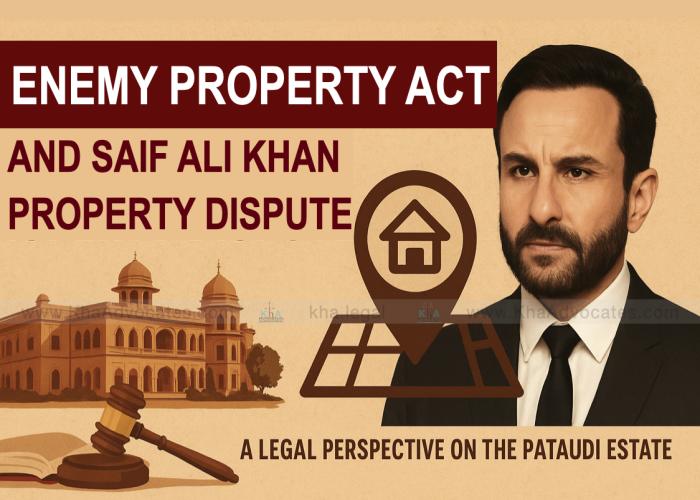
IntroductionThe Enemy Property Act, 1968 has often been in the news due to high-profile property disputes. One of the most talked-about cases involves Bollywood actor Saif Ali Khan and the prestigious Pataudi Estate. While many see this as a family inheritance matter, legally it is much more complicated, as the Enemy Property Act directly governs whether heirs like Saif can claim ownership of certain ancestral assets.This blog explores the legal perspective on the Enemy Property Act, its relevance to the Pataudi Estate dispute, and how it impacted Saif Ali Khan’s inheritance rights.What is the Enemy Property Act?The Enemy Property Act, 1968 was enacted by the Government of India after the Indo-Pak wars of 1965 and 1971. It essentially deals with properties left behind in India by people who migrated to Pakistan or China during these wars.Such properties were taken over by the Custodian of Enemy Property for India.Heirs of those who migrated were barred from claiming ownership rights.Even Indian citizens related to the “enemy” were restricted from succession to such properties.The law was strengthened further in 2017 through an amendment, making it clear that no heir of an enemy can inherit such property, even if they are Indian citizens.The Pataudi Estate Dispute – BackgroundThe Pataudi family, a prominent royal household in Haryana, traces its lineage back to Nawab Iftikhar Ali Khan and later Nawab Mansoor Ali Khan Pataudi. The estate included prime landholdings, palaces, and ancestral properties.The controversy began when it was argued that certain portions of the Pataudi Estate fell within the ambit of the Enemy Property Act due to the migration of some family members to Pakistan.This created legal hurdles in the inheritance of Saif Ali Khan, son of Mansoor Ali Khan Pataudi and Sharmila Tagore, despite him being an Indian citizen and legal heir.How the Enemy Property Act Affected the Pataudi Estate The legal complications arose because: • Some of Saif Ali Khan’s relatives, including family members connected to Bhopal and Hyderabad princely states, had migrated to Pakistan. • Under the Enemy Property Act, properties belonging to those relatives were considered enemy property. • This meant that even Indian-born heirs like Saif Ali Khan could not automatically inherit certain ancestral properties. Thus, while Saif was declared the legal heir to parts of the Pataudi Estate, the Enemy Property Act restricted his rights over portions of the ancestral property. How Did This Affect Saif Ali Khan? The direct impact of the Enemy Property Act on Saif Ali Khan was significant: 1. Inheritance Restriction – Saif could not freely inherit all properties linked to his ancestors because the law prohibited transfer of enemy property to heirs. 2. Legal Disputes & Delays – The Pataudi family faced litigation and government intervention, leading to a prolonged battle to establish ownership rights. 3. Loss of Royal Assets – Despite being the legal heir, Saif’s rights over parts of the estate were curtailed, preventing him from exercising full control. 4. Symbolic Loss of Heritage – For Saif, the dispute was not only about property value but also about ancestral pride and royal legacy. This demonstrates how even celebrity heirs are not immune to the far-reaching consequences of the Enemy Property ActLegal Perspective on the CaseFrom a legal standpoint, the dispute highlights several critical issues:Conflict between Succession Laws & Enemy Property ActNormally, under the Hindu Succession Act or personal laws, a son inherits his father’s property.However, the Enemy Property Act overrides succession rights, making heirs powerless if the property is classified as enemy property.Doctrine of Public PolicyThe Act is based on national interest, preventing properties linked to “enemies” from being exploited.But, in practice, it often impacts Indian citizens like Saif Ali Khan, raising concerns of fairness.Judicial InterpretationsIndian courts have consistently upheld the supremacy of the Act, limiting the scope of inheritance claims.This shows how special laws override general inheritance provisions.Lessons for Property Owners and HeirsThe Pataudi Estate dispute serves as a cautionary tale for families dealing with ancestral properties. Key lessons include:Title Verification is Crucial – Before claiming or buying any property, ensure it is not under the Enemy Property Act or other restrictions.Legal Documentation Matters – Proper succession deeds, wills, and title clearances can reduce future disputes.Seek Legal Expertise Early – Corporate lawyers and property law experts can prevent disputes from escalating into decades-long battles.NRI Families Must Be Extra Careful – Many NRIs unknowingly inherit properties linked to enemy properties, exposing them to long litigation.How Our Law Firm Can HelpAt KHA Advocates, we specialize in:Property Title Verification – Ensuring properties are free from legal encumbrances before purchase or transfer.Inheritance & Succession Advisory – Drafting wills, succession certificates, and family settlements to secure property rights.Dispute Resolution & Litigation Support – Representing clients in property disputes, including those under special laws like the Enemy Property Act.NRI Property Services – Helping NRIs manage, protect, and transfer their properties in India.If you’re facing property disputes or inheritance complications, our expert property lawyers can safeguard your rights.ConclusionThe Enemy Property Act was designed to protect national interests but has had profound implications on individual inheritance rights. The Saif Ali Khan Pataudi Estate dispute is a high-profile example of how this law can prevent rightful heirs from accessing ancestral property.For business owners, heirs, and NRIs, the key takeaway is clear: always seek legal due diligence and expert advice before claiming, buying, or transferring property👉 If you need guidance on property disputes, connect with KHA Advocates today and protect your rights before it’s too late.
Read More
For Canadians holding an Overseas Citizen of India (OCI) card who want to invest in Indian real estate without physically travelling to India, the question is common:👉 Can you buy property through a Power of Attorney (POA)?👉 What is the exact lawful process?👉 What are the required documents, legal risks, and government rules?This guide answers these questions in simple language — but with professional legal precision — so you and your family can make informed, compliant investment decisions in Indian property law.Can an OCI Card Holder Buy Property in India Without Coming to India?Yes — Generally, YesAs per Indian law under the Foreign Exchange Management Act (FEMA) and its Rules (especially Foreign Exchange Management (Non-Debt Instruments) Rules, 2019), an OCI card holder is legally allowed to:✅ Purchase residential & commercial property in India❌ Except agricultural land, plantation property, or farmhouses (unless inherited) Under FEMA Section 5 & Section 46, OCIs enjoy general permission to acquire immovable property without prior approval of the Reserve Bank of India (RBI), provided all payments are made through permissible banking channels. 📌 Important Legal Foundation📜 1. FEMA 1999 & Non-Debt Instruments RulesContains the core rules on foreign acquisition and transfer of immovable property.OCIs fall under the permitted class (similar to Non-Resident Indians (NRIs)).Purchase of residential or commercial property requires no RBI approval; agricultural-related property does. 📜 2. Transfer of Property Act, 1882Governs how property rights can be transferred through sale deeds, wills, or POA.Under Section 5 & Section 54 (Definitions) it recognises valid conveyance through registered instruments. 📜 3. Indian Registration Act, 1908All instruments dealing with immovable property (including sale deeds and POA) must be registered at the local Sub-Registrar’s office for legal effect.Notarised but unregistered POA is legally ineffective as a transfer instrument. Can a POA Be Used to Buy Property Without Physical Presence?Yes — But Only If Done Correctly.A Power of Attorney allows your appointed representative in India to act on your behalf for specific property dealings including:➡ Identifying property➡ Negotiating price➡ Signing the sale agreement➡ Executing the sale deed➡ Attending registration formalitiesBut there are legal requirements:1️⃣ Special/Specific Power of Attorney (SPA)a. Must be carefully drafted to clearly list powers — e.g., negotiation, signing agreements, registration, tax payments.b. A general POA is insufficient for property purchase. 2️⃣ Attestation/ApostilleIf executed outside India, the POA must be:a. Notarised in Canada (or local state)b. Then either:✔ Apostilled (if Canada is Hague member), or✔ Attested by the Indian Consulate/EmbassyThis ensures Indian authorities accept it as authentic. 3️⃣ Registration in IndiaThe POA must be:📍 Registered with the Sub-Registrar Office where the property is located📍 Paid applicable stamp duty (state-specific)Note: A notarised POA alone — without registration — is not legally effective to deal with property. 🧭 Step-by-Step Process to Buy Property via POA (Canadian OCI)This process helps you purchase legally and securely without traveling:🔎 Step 1: Identify the Propertya. Confirm seller’s titleb. Conduct title and encumbrance searchc. Ensure no litigation or fraud history‼ This is where legal due diligence done by an expert law firm like KHA Advocates protects you.🖋️ Step 2: Draft and Execute Power of AttorneyYour Canadian OCI must:✔ Choose the attorney (trustworthy person in India)✔ Draft a specific SPA✔ Notarise it in Canada (state)✔ Apostille/Consulate attestation✔ Ship properly sealed to India✔ Get it registered locally with stamp duty paid📌 POA must be time-bound, specific & covers registration authority.💸 Step 3: Arrange FEMA-Compliant PaymentPayment for property must follow FEMA guidelines:✅ Through inward remittanceOR✅ From your NRE, NRO, or FCNR(B) account❌ Cash/Foreign currency notes/Traveler’s cheques NOT ALLOWED. 📄 Step 4: Sale Agreement & RegistrationYour attorney will:1. Sign the Agreement to Sell2. Pay earnest deposit3. Prepare the Sale Deed4. Pay stamp duty & registration fees5. Register the sale deed at Sub-Registrar’s OfficeOnly a registered Sale Deed transfers ownership. — POA itself does not transfer rights legally. 🧾 Step 5: PAN & Tax ComplianceOCI must hold:✔ Indian PAN Card (Income Tax purpose)✔ Comply with TDS requirements (if applicable)✔ File Income Tax return if rental income earnedPAN is essential for registration and taxation. 🏦 Step 6: Repatriation of Sale Proceeds (Future)If the OCI sells later and wants to bring money abroad:✔ Repatriation of sale proceeds is allowed subject to RBI rules and compliance with FEMA and tax laws.📌 Common Legal Pitfalls to Avoid❌ Using a Notarised POA only without registration❌ Ambiguous or blank powers❌ POA not consulate-attested or apostilled❌ Missing PAN or TDS compliance❌ Paying outside permissible channelsYes — a Canadian OCI card holder can legally buy residential or commercial property in India without coming to the country, provided all legal formalities are followed, especially through a registered Power of Attorney and FEMA-compliant payment methods.This method is entirely lawful and widely used, but depends heavily on:✔ Properly drafted, attested & registered POA✔ Clear title & due diligence✔ RBI/FEMA compliance✔ Local Registration complianceWhy Choose KHA Advocates?We specialize in:✔ OCI & NRI Property Transactions✔ Power of Attorney Drafting & Registration✔ FEMA & RBI Compliance✔ Property Title Verification✔ Sale Deed Registration Support✔ Cross-Border Real Estate AdvisoryWe assist clients globally — including Canada, USA, UK, Australia & Middle East.Contact Details :KHA Advocates [Law Firm]Google Location : https://share.google/oFGKBu7PpPPNJalp0 New Town, Hatiara, Dhankal, Noapara, Kolkata, West Bengal 700157📞 Phone: +91-94-777-5-888-5📱 WhatsApp: +91-8010-555-666📧 Email: contact@khaadvocates.in🌐 Website: https://www.khaadvocates.com 🗓 Book Consultation: 👉 https://khaadvocates.com/book-consultation
Read More
Buying or selling a property is one of the biggest financial transactions of life. Yet, many people rush into it without proper legal guidance—only to face disputes, fraud, or loss later. The sale agreement and the sale deed are the backbone of any property transaction. Any mistake in these documents can cost you money, peace of mind, or even the property itself.That’s where a property lawyer plays a critical role. In this blog, we explain why you need a property lawyer for drafting and verifying your sale agreement and sale deed, the risks of not having one, relevant case laws, and how our law firm can help you.Why Are Sale Agreement and Sale Deed So Important?Sale Agreement: This is the preliminary contract that records the terms and conditions agreed upon between the buyer and the seller—price, payment schedule, possession date, default clauses, etc. It sets the foundation for the final sale deed.Sale Deed: This is the final registered document that transfers ownership of the property from the seller to the buyer. It is executed only after all obligations of the sale agreement are fulfilled.💡 Key Point: If the sale deed is not properly drafted and registered, your ownership rights are not legally secure.Common Problems People Face Without a Property LawyerHidden Liabilities – Many properties have unpaid loans, tax dues, or legal disputes. Buyers discover them only after purchase.Defective Titles – If the seller is not the real owner or if the property has multiple claimants, the sale deed can be challenged in court.Unclear Clauses – Vague language in the sale agreement can lead to disputes over possession, payment, or construction delays.Fraudulent Sales – Cases of fake documents, forged signatures, and double sales are common.Registration Issues – Errors in stamp duty, witness details, or registration can render the deed invalid.👉 Solution: A property lawyer conducts thorough due diligence, drafts foolproof agreements, and ensures your rights are protected.Role of a Property Lawyer in Drafting a Sale AgreementTitle Verification – Ensures that the seller has a clear, marketable title to the property.Encumbrance Check – Verifies whether the property is free from loans, mortgages, or litigation.Custom Drafting – Tailors clauses to protect the buyer’s or seller’s interest (payment schedule, penalty clauses, force majeure, etc.).Compliance with Law – Ensures the agreement follows provisions under the Indian Contract Act, 1872, Transfer of Property Act, 1882, and RERA (for under-construction projects).Safeguard Against Defaults – Drafts clear remedies if either party defaults.Role of a Property Lawyer in Drafting & Verifying a Sale DeedDrafting Ownership Transfer Clauses – Ensures that the rights, title, and interest are properly transferred.Stamp Duty & Registration – Calculates exact stamp duty and ensures proper registration under the Registration Act, 1908.Verification of Property Details – Correct description of property (survey no., boundaries, area, municipal records).Witness & Execution Formalities – Ensures that execution is legally valid with witnesses and signatures.Avoiding Future Disputes – Drafts clear indemnity and possession clauses to prevent litigation.Case Laws Highlighting Importance of Proper Sale DeedsSuraj Lamp & Industries Pvt. Ltd. v. State of Haryana (2011) 14 SCC 729The Supreme Court held that property transfer can only be done by a registered sale deed, not by GPA or agreement alone.Hardev Singh v. Gurmail Singh (2007) 2 SCC 404Court clarified that mere possession under an agreement does not give ownership rights; only a registered sale deed can.K.B. Saha & Sons Pvt. Ltd. v. Development Consultant Ltd. (2008) 8 SCC 564Highlighted that vague or incomplete clauses in property documents can cause disputes and litigation.💡 Takeaway: A poorly drafted or unregistered sale deed is a legal risk. Always use a property lawyer.How Property Lawyers Prevent FraudConducting a search in land records office for encumbrances.Checking mutation records and municipal approvals.Verifying RERA registration for under-construction projects.Scrutinizing previous chain of documents to ensure no breaks in ownership.Cross-checking with bank records if property is mortgaged.✨ Don’t risk your hard-earned money. Secure your property deal with KHA Advocates – experts in property law. From drafting to registration, we ensure a safe, transparent, and hassle-free property transaction.Frequently Asked Questions (FAQs)Q1: Can I buy property without a sale agreement?No. A sale agreement is essential to record terms before executing the final sale deed.Q2: Is notarization enough instead of registration?No. Only a registered sale deed under the Registration Act, 1908, gives you legal ownership.Q3: Can I draft my own sale deed?Technically yes, but it is risky. Property law is complex. Errors can lead to disputes or even cancellation of the sale.Q4: How much does a property lawyer charge for sale deed drafting?Charges vary depending on complexity, location, and property value. At KHA Advocates, we provide cost-effective, transparent legal services.Q5: What if the seller refuses to execute the sale deed after agreement?You can file a Suit for Specific Performance under the Specific Relief Act, 1963. A lawyer will represent you in court.Contact KHA Advocates — Your Property Law Partner📍 Office: KHA Advocates – Property & Real Estate Legal Services📞 Phone : (+91) 94-777-5-888-5📞 WhatsApp: (+91) 8101-555-666📧 Email: contact@khaadvocates.in🌐 Website: www.khaadvocates.com🔗 Quick Appointment Link: https://khaadvocates.com/book-consultation👉 Call us today to book a consultation with our expert property lawyers before signing your sale agreement or sale deed.
Read More
🔹 IntroductionBuying property in New Town, Kolkata is a dream for many. But property registration is not just paperwork — it’s a legal safeguard that determines whether your investment is truly secure. A single mistake can cost you ownership rights, money, and years in court battles.👉 This is why you need a Property Registration Lawyer — to make sure your purchase is legally valid, dispute-free, and future-proof.🔹 What is Property Registration?📖 Under the Registration Act, 1908, property transactions above ₹100 must be registered.📌 Registration = official proof of ownership.📌 Without registration = property has no legal value.In West Bengal, registration also requires compliance with the Stamp Act & Registration Rules.⚠️ Problems Buyers Face Without a Lawyer🚫 Fake/forged documents from sellers🚫 Property under litigation or mortgage🚫 Wrong calculation of stamp duty → penalties🚫 Poorly drafted Sale Deed favoring seller🚫 Encroachment & ownership disputes👉 Solution: Hire a lawyer for due diligence + drafting + registration.🔹 How a Property Registration Lawyer Helps YouA Property Registration Lawyer provides end-to-end support in:a) Title Verification & Due DiligenceChecking original ownership documents (deed, khatian, mutation, tax receipts).Ensuring the property is free from litigation, mortgage, or encumbrance.Searching records at the Sub-Registrar’s office.b) Drafting & Reviewing the Sale DeedCustomizing clauses to protect the buyer’s rights.Ensuring there is no vague language that may favor the seller.Including indemnity clauses against future disputes.c) Stamp Duty & RegistrationCorrectly calculating stamp duty and fees under West Bengal Stamp Act.Filing the necessary documents with the Sub-Registrar.d) Execution & HandoverEnsuring smooth registration before the registering officer.Obtaining the certified copy of the registered deed.Advising on mutation and municipal tax transfer post-registration.Let's Summarise for you ✅ Title Verification – checks deeds, khatian, mutation, encumbrances✅ Drafting Sale Deed – buyer-friendly clauses, indemnity terms✅ Stamp Duty & Fees – accurate calculation under WB law✅ Registration Process – smooth execution at Sub-Registrar’s office✅ Post-registration – mutation, tax transfer, possession⚖️ Case Laws You Must KnowSuraj Lamp & Industries v. State of Haryana (2011) – Only a registered deed transfers ownership.K.B. Saha & Sons v. Development Consultant Ltd. (2008) – Unregistered documents = no legal proof of ownership.👉 Moral: Without proper legal registration, you don’t own the property.🏙️ Why Special Care in New Town, Kolkata?Most properties in New Town are leasehold under HIDCO.⚠️ Risks:Government permission needed for transferLease restrictions applyWrong drafting = cancellation of allotment👉 Only a lawyer experienced in HIDCO leasehold rules can protect you.✅ How We Help at KHA Advocates🔹 Title search + due diligence🔹 Custom deed drafting🔹 Registration at Sub-Registrar’s office🔹 NRI buyer assistance via Power of Attorney🔹 Post-registration services (mutation, tax, possession)💡 We make property registration 100% safe, legal, and stress-free.❓ FAQsQ1: Is a lawyer mandatory for property registration?➡ No, but without one, you risk fraud & defective deeds.Q2: Can NRIs register without visiting India?➡ Yes, via Power of Attorney.Q3: How long does registration take?➡ 2–4 weeks depending on clearances.📞 Contact Us TodayDon’t risk your dream home or investment. Protect it with expert legal help.📲 Call: (+91) 94-777-5-888-5📲 WhatsApp: (+91) 8101-555-666📧 Email: contact@khaadvocates.in🌐 Website: www.khaadvocates.com🔗 Book Appointment: https://khaadvocates.com/book-consultationProperty registration is the foundation of ownership. In places like New Town, Kolkata, where leasehold rules make transactions tricky, hiring a Property Registration Lawyer ensures your investment is safe, legal, and hassle-free.👉 Choose smart. Choose legal security. Choose KHA Advocates.
Read More
IntroductionBuying your dream home is one of the biggest financial and emotional decisions of life. Many buyers, especially first-time buyers, are drawn towards under-construction flats or apartments because they are often cheaper than ready-to-move-in properties and come with flexible payment options. However, under-construction properties also involve higher risks, such as project delays, legal disputes, or even fraud.As a buyer, knowing the legal process, safety measures, and essential do’s & don’ts can help you secure your investment and avoid unnecessary stress.At KHA Advocates, we assist property buyers with end-to-end legal support, from due diligence to registration, ensuring you buy your home with complete confidence.Step-by-Step Legal Process of Buying an Under-Construction Flat1. Check RERA RegistrationVisit your state’s RERA (Real Estate Regulatory Authority) portal.Verify whether the project is registered.Check the builder’s past projects, timelines, and compliance status.👉 Why it matters: Only RERA-approved projects provide legal safeguards for buyers.2. Verify Builder’s Title & ApprovalsConfirm the builder has clear ownership or development rights over the land.Check approvals from local authorities (municipality, fire, environmental clearance, etc.).👉 Why it matters: Buying from a builder without proper approvals can lead to cancellation of the project.3. Examine the Builder-Buyer AgreementCarefully review clauses on possession date, construction linked payments, cancellation, and refund policies.Look for hidden charges (maintenance, parking, club membership, etc.).👉 Why it matters: This agreement defines your rights – a lawyer can help negotiate unfavorable terms.4. Payment & Home Loan ProcedurePayments should follow the construction-linked plan and not exceed 10% before agreement registration (as per RERA).For home loans, banks conduct their due diligence – but don’t rely solely on bank approvals.5. Registration of Agreement for SaleLegally register your agreement at the Sub-Registrar’s office.Pay applicable stamp duty & registration charges.6. Possession & Occupancy CertificateBefore possession, check for Occupancy Certificate (OC) and Completion Certificate (CC).Without these, the property is legally incomplete.Safety Measures Before Booking an Under-Construction Flat✅ Check Builder’s Reputation – Past delays, litigation, financial standing.✅ Verify Carpet Area – RERA mandates selling on carpet area, not super built-up.✅ Escrow Account Compliance – Ensure builder deposits 70% of buyer’s funds in RERA account.✅ Timely Updates – RERA requires builders to provide construction progress updates online.✅ Legal Scrutiny of All Documents – Hire a property lawyer to verify every paper.Do’s & Don’ts List for Buyers✅ Do’s:Do verify the project’s RERA registration.Do conduct a legal title check of the land.Do hire a real estate lawyer for document vetting.Do keep all receipts, agreements, and builder communication in writing.Do check for hidden charges like GST, maintenance, parking.❌ Don’ts:Don’t rely solely on the builder’s brochure or promises.Don’t pay more than 10% of the cost before agreement registration.Don’t skip checking OC & CC before taking possession.Don’t ignore the fine print in the builder-buyer agreement.Don’t book based only on verbal assurances or flashy advertisements.Case Study: Buyers Saved by Legal Due DiligenceA group of buyers in Kolkata booked flats in an under-construction project that was heavily advertised. Our team at KHA Advocates was approached for due diligence. Upon inspection, we found that:The land title had a pending litigation.The builder had failed to secure environmental clearance.By acting early, the buyers avoided investing in a risky project and redirected their funds into a RERA-compliant development.👉 Lesson: A small investment in legal checks can save you from losing your life savings.Why You Need a Real Estate Lawyer for Under-Construction PropertiesContract Protection – Lawyers help negotiate builder-buyer agreements to protect your interests.Fraud Prevention – Prevents scams by verifying builder credentials and land titles.Compliance Checks – Ensures approvals and sanctions are in place.Dispute Resolution – Quick legal recourse in case of delays or defaults.Peace of Mind – Focus on your dream home while your lawyer safeguards your investment.ConclusionBuying an under-construction flat can be rewarding, but it comes with risks that only expert legal guidance can minimize. Don’t let hidden clauses, delayed possession, or fraud turn your dream home into a nightmare.At KHA Advocates, we specialize in property law and real estate legal services. From document verification to dispute resolution, we ensure that your home-buying journey is secure, transparent, and stress-free.👉 Build your dream home with confidence – Partner with KHA Advocates today!📞 Contact Us: +91-9477758885📧 Email: contact@khaadvocates.in📍 Location: New Town, Near CC2, Kolkata, West Bengal, India🌐 Visit: www.khaadvocates.com
Read More
For Canadians holding an Overseas Citizen of India (OCI) card who want to invest in Indian real estate without physically travelling to India, the question is common:👉 Can you buy property through a Power of Attorney (POA)?👉 What is the exact lawful process?👉 What are the required documents, legal risks, and government rules?This guide answers these questions in simple language — but with professional legal precision — so you and your family can make informed, compliant investment decisions in Indian property law.Can an OCI Card Holder Buy Property in India Without Coming to India?Yes — Generally, YesAs per Indian law under the Foreign Exchange Management Act (FEMA) and its Rules (especially Foreign Exchange Management (Non-Debt Instruments) Rules, 2019), an OCI card holder is legally allowed to:✅ Purchase residential & commercial property in India❌ Except agricultural land, plantation property, or farmhouses (unless inherited) Under FEMA Section 5 & Section 46, OCIs enjoy general permission to acquire immovable property without prior approval of the Reserve Bank of India (RBI), provided all payments are made through permissible banking channels. 📌 Important Legal Foundation📜 1. FEMA 1999 & Non-Debt Instruments RulesContains the core rules on foreign acquisition and transfer of immovable property.OCIs fall under the permitted class (similar to Non-Resident Indians (NRIs)).Purchase of residential or commercial property requires no RBI approval; agricultural-related property does. 📜 2. Transfer of Property Act, 1882Governs how property rights can be transferred through sale deeds, wills, or POA.Under Section 5 & Section 54 (Definitions) it recognises valid conveyance through registered instruments. 📜 3. Indian Registration Act, 1908All instruments dealing with immovable property (including sale deeds and POA) must be registered at the local Sub-Registrar’s office for legal effect.Notarised but unregistered POA is legally ineffective as a transfer instrument. Can a POA Be Used to Buy Property Without Physical Presence?Yes — But Only If Done Correctly.A Power of Attorney allows your appointed representative in India to act on your behalf for specific property dealings including:➡ Identifying property➡ Negotiating price➡ Signing the sale agreement➡ Executing the sale deed➡ Attending registration formalitiesBut there are legal requirements:1️⃣ Special/Specific Power of Attorney (SPA)a. Must be carefully drafted to clearly list powers — e.g., negotiation, signing agreements, registration, tax payments.b. A general POA is insufficient for property purchase. 2️⃣ Attestation/ApostilleIf executed outside India, the POA must be:a. Notarised in Canada (or local state)b. Then either:✔ Apostilled (if Canada is Hague member), or✔ Attested by the Indian Consulate/EmbassyThis ensures Indian authorities accept it as authentic. 3️⃣ Registration in IndiaThe POA must be:📍 Registered with the Sub-Registrar Office where the property is located📍 Paid applicable stamp duty (state-specific)Note: A notarised POA alone — without registration — is not legally effective to deal with property. 🧭 Step-by-Step Process to Buy Property via POA (Canadian OCI)This process helps you purchase legally and securely without traveling:🔎 Step 1: Identify the Propertya. Confirm seller’s titleb. Conduct title and encumbrance searchc. Ensure no litigation or fraud history‼ This is where legal due diligence done by an expert law firm like KHA Advocates protects you.🖋️ Step 2: Draft and Execute Power of AttorneyYour Canadian OCI must:✔ Choose the attorney (trustworthy person in India)✔ Draft a specific SPA✔ Notarise it in Canada (state)✔ Apostille/Consulate attestation✔ Ship properly sealed to India✔ Get it registered locally with stamp duty paid📌 POA must be time-bound, specific & covers registration authority.💸 Step 3: Arrange FEMA-Compliant PaymentPayment for property must follow FEMA guidelines:✅ Through inward remittanceOR✅ From your NRE, NRO, or FCNR(B) account❌ Cash/Foreign currency notes/Traveler’s cheques NOT ALLOWED. 📄 Step 4: Sale Agreement & RegistrationYour attorney will:1. Sign the Agreement to Sell2. Pay earnest deposit3. Prepare the Sale Deed4. Pay stamp duty & registration fees5. Register the sale deed at Sub-Registrar’s OfficeOnly a registered Sale Deed transfers ownership. — POA itself does not transfer rights legally. 🧾 Step 5: PAN & Tax ComplianceOCI must hold:✔ Indian PAN Card (Income Tax purpose)✔ Comply with TDS requirements (if applicable)✔ File Income Tax return if rental income earnedPAN is essential for registration and taxation. 🏦 Step 6: Repatriation of Sale Proceeds (Future)If the OCI sells later and wants to bring money abroad:✔ Repatriation of sale proceeds is allowed subject to RBI rules and compliance with FEMA and tax laws.📌 Common Legal Pitfalls to Avoid❌ Using a Notarised POA only without registration❌ Ambiguous or blank powers❌ POA not consulate-attested or apostilled❌ Missing PAN or TDS compliance❌ Paying outside permissible channelsYes — a Canadian OCI card holder can legally buy residential or commercial property in India without coming to the country, provided all legal formalities are followed, especially through a registered Power of Attorney and FEMA-compliant payment methods.This method is entirely lawful and widely used, but depends heavily on:✔ Properly drafted, attested & registered POA✔ Clear title & due diligence✔ RBI/FEMA compliance✔ Local Registration complianceWhy Choose KHA Advocates?We specialize in:✔ OCI & NRI Property Transactions✔ Power of Attorney Drafting & Registration✔ FEMA & RBI Compliance✔ Property Title Verification✔ Sale Deed Registration Support✔ Cross-Border Real Estate AdvisoryWe assist clients globally — including Canada, USA, UK, Australia & Middle East.Contact Details :KHA Advocates [Law Firm]Google Location : https://share.google/oFGKBu7PpPPNJalp0 New Town, Hatiara, Dhankal, Noapara, Kolkata, West Bengal 700157📞 Phone: +91-94-777-5-888-5📱 WhatsApp: +91-8010-555-666📧 Email: contact@khaadvocates.in🌐 Website: https://www.khaadvocates.com 🗓 Book Consultation: 👉 https://khaadvocates.com/book-consultation
Read More
Buying or selling a property is one of the biggest financial transactions of life. Yet, many people rush into it without proper legal guidance—only to face disputes, fraud, or loss later. The sale agreement and the sale deed are the backbone of any property transaction. Any mistake in these documents can cost you money, peace of mind, or even the property itself.That’s where a property lawyer plays a critical role. In this blog, we explain why you need a property lawyer for drafting and verifying your sale agreement and sale deed, the risks of not having one, relevant case laws, and how our law firm can help you.Why Are Sale Agreement and Sale Deed So Important?Sale Agreement: This is the preliminary contract that records the terms and conditions agreed upon between the buyer and the seller—price, payment schedule, possession date, default clauses, etc. It sets the foundation for the final sale deed.Sale Deed: This is the final registered document that transfers ownership of the property from the seller to the buyer. It is executed only after all obligations of the sale agreement are fulfilled.💡 Key Point: If the sale deed is not properly drafted and registered, your ownership rights are not legally secure.Common Problems People Face Without a Property LawyerHidden Liabilities – Many properties have unpaid loans, tax dues, or legal disputes. Buyers discover them only after purchase.Defective Titles – If the seller is not the real owner or if the property has multiple claimants, the sale deed can be challenged in court.Unclear Clauses – Vague language in the sale agreement can lead to disputes over possession, payment, or construction delays.Fraudulent Sales – Cases of fake documents, forged signatures, and double sales are common.Registration Issues – Errors in stamp duty, witness details, or registration can render the deed invalid.👉 Solution: A property lawyer conducts thorough due diligence, drafts foolproof agreements, and ensures your rights are protected.Role of a Property Lawyer in Drafting a Sale AgreementTitle Verification – Ensures that the seller has a clear, marketable title to the property.Encumbrance Check – Verifies whether the property is free from loans, mortgages, or litigation.Custom Drafting – Tailors clauses to protect the buyer’s or seller’s interest (payment schedule, penalty clauses, force majeure, etc.).Compliance with Law – Ensures the agreement follows provisions under the Indian Contract Act, 1872, Transfer of Property Act, 1882, and RERA (for under-construction projects).Safeguard Against Defaults – Drafts clear remedies if either party defaults.Role of a Property Lawyer in Drafting & Verifying a Sale DeedDrafting Ownership Transfer Clauses – Ensures that the rights, title, and interest are properly transferred.Stamp Duty & Registration – Calculates exact stamp duty and ensures proper registration under the Registration Act, 1908.Verification of Property Details – Correct description of property (survey no., boundaries, area, municipal records).Witness & Execution Formalities – Ensures that execution is legally valid with witnesses and signatures.Avoiding Future Disputes – Drafts clear indemnity and possession clauses to prevent litigation.Case Laws Highlighting Importance of Proper Sale DeedsSuraj Lamp & Industries Pvt. Ltd. v. State of Haryana (2011) 14 SCC 729The Supreme Court held that property transfer can only be done by a registered sale deed, not by GPA or agreement alone.Hardev Singh v. Gurmail Singh (2007) 2 SCC 404Court clarified that mere possession under an agreement does not give ownership rights; only a registered sale deed can.K.B. Saha & Sons Pvt. Ltd. v. Development Consultant Ltd. (2008) 8 SCC 564Highlighted that vague or incomplete clauses in property documents can cause disputes and litigation.💡 Takeaway: A poorly drafted or unregistered sale deed is a legal risk. Always use a property lawyer.How Property Lawyers Prevent FraudConducting a search in land records office for encumbrances.Checking mutation records and municipal approvals.Verifying RERA registration for under-construction projects.Scrutinizing previous chain of documents to ensure no breaks in ownership.Cross-checking with bank records if property is mortgaged.✨ Don’t risk your hard-earned money. Secure your property deal with KHA Advocates – experts in property law. From drafting to registration, we ensure a safe, transparent, and hassle-free property transaction.Frequently Asked Questions (FAQs)Q1: Can I buy property without a sale agreement?No. A sale agreement is essential to record terms before executing the final sale deed.Q2: Is notarization enough instead of registration?No. Only a registered sale deed under the Registration Act, 1908, gives you legal ownership.Q3: Can I draft my own sale deed?Technically yes, but it is risky. Property law is complex. Errors can lead to disputes or even cancellation of the sale.Q4: How much does a property lawyer charge for sale deed drafting?Charges vary depending on complexity, location, and property value. At KHA Advocates, we provide cost-effective, transparent legal services.Q5: What if the seller refuses to execute the sale deed after agreement?You can file a Suit for Specific Performance under the Specific Relief Act, 1963. A lawyer will represent you in court.Contact KHA Advocates — Your Property Law Partner📍 Office: KHA Advocates – Property & Real Estate Legal Services📞 Phone : (+91) 94-777-5-888-5📞 WhatsApp: (+91) 8101-555-666📧 Email: contact@khaadvocates.in🌐 Website: www.khaadvocates.com🔗 Quick Appointment Link: https://khaadvocates.com/book-consultation👉 Call us today to book a consultation with our expert property lawyers before signing your sale agreement or sale deed.
Read More
IntroductionBuying your dream home is one of the biggest financial and emotional decisions of life. Many buyers, especially first-time buyers, are drawn towards under-construction flats or apartments because they are often cheaper than ready-to-move-in properties and come with flexible payment options. However, under-construction properties also involve higher risks, such as project delays, legal disputes, or even fraud.As a buyer, knowing the legal process, safety measures, and essential do’s & don’ts can help you secure your investment and avoid unnecessary stress.At KHA Advocates, we assist property buyers with end-to-end legal support, from due diligence to registration, ensuring you buy your home with complete confidence.Step-by-Step Legal Process of Buying an Under-Construction Flat1. Check RERA RegistrationVisit your state’s RERA (Real Estate Regulatory Authority) portal.Verify whether the project is registered.Check the builder’s past projects, timelines, and compliance status.👉 Why it matters: Only RERA-approved projects provide legal safeguards for buyers.2. Verify Builder’s Title & ApprovalsConfirm the builder has clear ownership or development rights over the land.Check approvals from local authorities (municipality, fire, environmental clearance, etc.).👉 Why it matters: Buying from a builder without proper approvals can lead to cancellation of the project.3. Examine the Builder-Buyer AgreementCarefully review clauses on possession date, construction linked payments, cancellation, and refund policies.Look for hidden charges (maintenance, parking, club membership, etc.).👉 Why it matters: This agreement defines your rights – a lawyer can help negotiate unfavorable terms.4. Payment & Home Loan ProcedurePayments should follow the construction-linked plan and not exceed 10% before agreement registration (as per RERA).For home loans, banks conduct their due diligence – but don’t rely solely on bank approvals.5. Registration of Agreement for SaleLegally register your agreement at the Sub-Registrar’s office.Pay applicable stamp duty & registration charges.6. Possession & Occupancy CertificateBefore possession, check for Occupancy Certificate (OC) and Completion Certificate (CC).Without these, the property is legally incomplete.Safety Measures Before Booking an Under-Construction Flat✅ Check Builder’s Reputation – Past delays, litigation, financial standing.✅ Verify Carpet Area – RERA mandates selling on carpet area, not super built-up.✅ Escrow Account Compliance – Ensure builder deposits 70% of buyer’s funds in RERA account.✅ Timely Updates – RERA requires builders to provide construction progress updates online.✅ Legal Scrutiny of All Documents – Hire a property lawyer to verify every paper.Do’s & Don’ts List for Buyers✅ Do’s:Do verify the project’s RERA registration.Do conduct a legal title check of the land.Do hire a real estate lawyer for document vetting.Do keep all receipts, agreements, and builder communication in writing.Do check for hidden charges like GST, maintenance, parking.❌ Don’ts:Don’t rely solely on the builder’s brochure or promises.Don’t pay more than 10% of the cost before agreement registration.Don’t skip checking OC & CC before taking possession.Don’t ignore the fine print in the builder-buyer agreement.Don’t book based only on verbal assurances or flashy advertisements.Case Study: Buyers Saved by Legal Due DiligenceA group of buyers in Kolkata booked flats in an under-construction project that was heavily advertised. Our team at KHA Advocates was approached for due diligence. Upon inspection, we found that:The land title had a pending litigation.The builder had failed to secure environmental clearance.By acting early, the buyers avoided investing in a risky project and redirected their funds into a RERA-compliant development.👉 Lesson: A small investment in legal checks can save you from losing your life savings.Why You Need a Real Estate Lawyer for Under-Construction PropertiesContract Protection – Lawyers help negotiate builder-buyer agreements to protect your interests.Fraud Prevention – Prevents scams by verifying builder credentials and land titles.Compliance Checks – Ensures approvals and sanctions are in place.Dispute Resolution – Quick legal recourse in case of delays or defaults.Peace of Mind – Focus on your dream home while your lawyer safeguards your investment.ConclusionBuying an under-construction flat can be rewarding, but it comes with risks that only expert legal guidance can minimize. Don’t let hidden clauses, delayed possession, or fraud turn your dream home into a nightmare.At KHA Advocates, we specialize in property law and real estate legal services. From document verification to dispute resolution, we ensure that your home-buying journey is secure, transparent, and stress-free.👉 Build your dream home with confidence – Partner with KHA Advocates today!📞 Contact Us: +91-9477758885📧 Email: contact@khaadvocates.in📍 Location: New Town, Near CC2, Kolkata, West Bengal, India🌐 Visit: www.khaadvocates.com
Read More
IntroductionThe Enemy Property Act, 1968 has often been in the news due to high-profile property disputes. One of the most talked-about cases involves Bollywood actor Saif Ali Khan and the prestigious Pataudi Estate. While many see this as a family inheritance matter, legally it is much more complicated, as the Enemy Property Act directly governs whether heirs like Saif can claim ownership of certain ancestral assets.This blog explores the legal perspective on the Enemy Property Act, its relevance to the Pataudi Estate dispute, and how it impacted Saif Ali Khan’s inheritance rights.What is the Enemy Property Act?The Enemy Property Act, 1968 was enacted by the Government of India after the Indo-Pak wars of 1965 and 1971. It essentially deals with properties left behind in India by people who migrated to Pakistan or China during these wars.Such properties were taken over by the Custodian of Enemy Property for India.Heirs of those who migrated were barred from claiming ownership rights.Even Indian citizens related to the “enemy” were restricted from succession to such properties.The law was strengthened further in 2017 through an amendment, making it clear that no heir of an enemy can inherit such property, even if they are Indian citizens.The Pataudi Estate Dispute – BackgroundThe Pataudi family, a prominent royal household in Haryana, traces its lineage back to Nawab Iftikhar Ali Khan and later Nawab Mansoor Ali Khan Pataudi. The estate included prime landholdings, palaces, and ancestral properties.The controversy began when it was argued that certain portions of the Pataudi Estate fell within the ambit of the Enemy Property Act due to the migration of some family members to Pakistan.This created legal hurdles in the inheritance of Saif Ali Khan, son of Mansoor Ali Khan Pataudi and Sharmila Tagore, despite him being an Indian citizen and legal heir.How the Enemy Property Act Affected the Pataudi Estate The legal complications arose because: • Some of Saif Ali Khan’s relatives, including family members connected to Bhopal and Hyderabad princely states, had migrated to Pakistan. • Under the Enemy Property Act, properties belonging to those relatives were considered enemy property. • This meant that even Indian-born heirs like Saif Ali Khan could not automatically inherit certain ancestral properties. Thus, while Saif was declared the legal heir to parts of the Pataudi Estate, the Enemy Property Act restricted his rights over portions of the ancestral property. How Did This Affect Saif Ali Khan? The direct impact of the Enemy Property Act on Saif Ali Khan was significant: 1. Inheritance Restriction – Saif could not freely inherit all properties linked to his ancestors because the law prohibited transfer of enemy property to heirs. 2. Legal Disputes & Delays – The Pataudi family faced litigation and government intervention, leading to a prolonged battle to establish ownership rights. 3. Loss of Royal Assets – Despite being the legal heir, Saif’s rights over parts of the estate were curtailed, preventing him from exercising full control. 4. Symbolic Loss of Heritage – For Saif, the dispute was not only about property value but also about ancestral pride and royal legacy. This demonstrates how even celebrity heirs are not immune to the far-reaching consequences of the Enemy Property ActLegal Perspective on the CaseFrom a legal standpoint, the dispute highlights several critical issues:Conflict between Succession Laws & Enemy Property ActNormally, under the Hindu Succession Act or personal laws, a son inherits his father’s property.However, the Enemy Property Act overrides succession rights, making heirs powerless if the property is classified as enemy property.Doctrine of Public PolicyThe Act is based on national interest, preventing properties linked to “enemies” from being exploited.But, in practice, it often impacts Indian citizens like Saif Ali Khan, raising concerns of fairness.Judicial InterpretationsIndian courts have consistently upheld the supremacy of the Act, limiting the scope of inheritance claims.This shows how special laws override general inheritance provisions.Lessons for Property Owners and HeirsThe Pataudi Estate dispute serves as a cautionary tale for families dealing with ancestral properties. Key lessons include:Title Verification is Crucial – Before claiming or buying any property, ensure it is not under the Enemy Property Act or other restrictions.Legal Documentation Matters – Proper succession deeds, wills, and title clearances can reduce future disputes.Seek Legal Expertise Early – Corporate lawyers and property law experts can prevent disputes from escalating into decades-long battles.NRI Families Must Be Extra Careful – Many NRIs unknowingly inherit properties linked to enemy properties, exposing them to long litigation.How Our Law Firm Can HelpAt KHA Advocates, we specialize in:Property Title Verification – Ensuring properties are free from legal encumbrances before purchase or transfer.Inheritance & Succession Advisory – Drafting wills, succession certificates, and family settlements to secure property rights.Dispute Resolution & Litigation Support – Representing clients in property disputes, including those under special laws like the Enemy Property Act.NRI Property Services – Helping NRIs manage, protect, and transfer their properties in India.If you’re facing property disputes or inheritance complications, our expert property lawyers can safeguard your rights.ConclusionThe Enemy Property Act was designed to protect national interests but has had profound implications on individual inheritance rights. The Saif Ali Khan Pataudi Estate dispute is a high-profile example of how this law can prevent rightful heirs from accessing ancestral property.For business owners, heirs, and NRIs, the key takeaway is clear: always seek legal due diligence and expert advice before claiming, buying, or transferring property👉 If you need guidance on property disputes, connect with KHA Advocates today and protect your rights before it’s too late.
Read More


Specialized legal support for first-time property buyers, ensuring clarity, confidence, and peace of mind throughout the process.

🔹 IntroductionBuying property in New Town, Kolkata is a dream for many. But property registration is not just paperwork — it’s a legal safeguard that determines whether your investment is truly secure. A single mistake can cost you ownership rights, money, and years in court battles.👉 This is why you need a Property Registration Lawyer — to make sure your purchase is legally valid, dispute-free, and future-proof.🔹 What is Property Registration?📖 Under the Registration Act, 1908, property transactions above ₹100 must be registered.📌 Registration = official proof of ownership.📌 Without registration = property has no legal value.In West Bengal, registration also requires compliance with the Stamp Act & Registration Rules.⚠️ Problems Buyers Face Without a Lawyer🚫 Fake/forged documents from sellers🚫 Property under litigation or mortgage🚫 Wrong calculation of stamp duty → penalties🚫 Poorly drafted Sale Deed favoring seller🚫 Encroachment & ownership disputes👉 Solution: Hire a lawyer for due diligence + drafting + registration.🔹 How a Property Registration Lawyer Helps YouA Property Registration Lawyer provides end-to-end support in:a) Title Verification & Due DiligenceChecking original ownership documents (deed, khatian, mutation, tax receipts).Ensuring the property is free from litigation, mortgage, or encumbrance.Searching records at the Sub-Registrar’s office.b) Drafting & Reviewing the Sale DeedCustomizing clauses to protect the buyer’s rights.Ensuring there is no vague language that may favor the seller.Including indemnity clauses against future disputes.c) Stamp Duty & RegistrationCorrectly calculating stamp duty and fees under West Bengal Stamp Act.Filing the necessary documents with the Sub-Registrar.d) Execution & HandoverEnsuring smooth registration before the registering officer.Obtaining the certified copy of the registered deed.Advising on mutation and municipal tax transfer post-registration.Let's Summarise for you ✅ Title Verification – checks deeds, khatian, mutation, encumbrances✅ Drafting Sale Deed – buyer-friendly clauses, indemnity terms✅ Stamp Duty & Fees – accurate calculation under WB law✅ Registration Process – smooth execution at Sub-Registrar’s office✅ Post-registration – mutation, tax transfer, possession⚖️ Case Laws You Must KnowSuraj Lamp & Industries v. State of Haryana (2011) – Only a registered deed transfers ownership.K.B. Saha & Sons v. Development Consultant Ltd. (2008) – Unregistered documents = no legal proof of ownership.👉 Moral: Without proper legal registration, you don’t own the property.🏙️ Why Special Care in New Town, Kolkata?Most properties in New Town are leasehold under HIDCO.⚠️ Risks:Government permission needed for transferLease restrictions applyWrong drafting = cancellation of allotment👉 Only a lawyer experienced in HIDCO leasehold rules can protect you.✅ How We Help at KHA Advocates🔹 Title search + due diligence🔹 Custom deed drafting🔹 Registration at Sub-Registrar’s office🔹 NRI buyer assistance via Power of Attorney🔹 Post-registration services (mutation, tax, possession)💡 We make property registration 100% safe, legal, and stress-free.❓ FAQsQ1: Is a lawyer mandatory for property registration?➡ No, but without one, you risk fraud & defective deeds.Q2: Can NRIs register without visiting India?➡ Yes, via Power of Attorney.Q3: How long does registration take?➡ 2–4 weeks depending on clearances.📞 Contact Us TodayDon’t risk your dream home or investment. Protect it with expert legal help.📲 Call: (+91) 94-777-5-888-5📲 WhatsApp: (+91) 8101-555-666📧 Email: contact@khaadvocates.in🌐 Website: www.khaadvocates.com🔗 Book Appointment: https://khaadvocates.com/book-consultationProperty registration is the foundation of ownership. In places like New Town, Kolkata, where leasehold rules make transactions tricky, hiring a Property Registration Lawyer ensures your investment is safe, legal, and hassle-free.👉 Choose smart. Choose legal security. Choose KHA Advocates.
Read More
IntroductionBuying your dream home is one of the biggest financial and emotional decisions of life. Many buyers, especially first-time buyers, are drawn towards under-construction flats or apartments because they are often cheaper than ready-to-move-in properties and come with flexible payment options. However, under-construction properties also involve higher risks, such as project delays, legal disputes, or even fraud.As a buyer, knowing the legal process, safety measures, and essential do’s & don’ts can help you secure your investment and avoid unnecessary stress.At KHA Advocates, we assist property buyers with end-to-end legal support, from due diligence to registration, ensuring you buy your home with complete confidence.Step-by-Step Legal Process of Buying an Under-Construction Flat1. Check RERA RegistrationVisit your state’s RERA (Real Estate Regulatory Authority) portal.Verify whether the project is registered.Check the builder’s past projects, timelines, and compliance status.👉 Why it matters: Only RERA-approved projects provide legal safeguards for buyers.2. Verify Builder’s Title & ApprovalsConfirm the builder has clear ownership or development rights over the land.Check approvals from local authorities (municipality, fire, environmental clearance, etc.).👉 Why it matters: Buying from a builder without proper approvals can lead to cancellation of the project.3. Examine the Builder-Buyer AgreementCarefully review clauses on possession date, construction linked payments, cancellation, and refund policies.Look for hidden charges (maintenance, parking, club membership, etc.).👉 Why it matters: This agreement defines your rights – a lawyer can help negotiate unfavorable terms.4. Payment & Home Loan ProcedurePayments should follow the construction-linked plan and not exceed 10% before agreement registration (as per RERA).For home loans, banks conduct their due diligence – but don’t rely solely on bank approvals.5. Registration of Agreement for SaleLegally register your agreement at the Sub-Registrar’s office.Pay applicable stamp duty & registration charges.6. Possession & Occupancy CertificateBefore possession, check for Occupancy Certificate (OC) and Completion Certificate (CC).Without these, the property is legally incomplete.Safety Measures Before Booking an Under-Construction Flat✅ Check Builder’s Reputation – Past delays, litigation, financial standing.✅ Verify Carpet Area – RERA mandates selling on carpet area, not super built-up.✅ Escrow Account Compliance – Ensure builder deposits 70% of buyer’s funds in RERA account.✅ Timely Updates – RERA requires builders to provide construction progress updates online.✅ Legal Scrutiny of All Documents – Hire a property lawyer to verify every paper.Do’s & Don’ts List for Buyers✅ Do’s:Do verify the project’s RERA registration.Do conduct a legal title check of the land.Do hire a real estate lawyer for document vetting.Do keep all receipts, agreements, and builder communication in writing.Do check for hidden charges like GST, maintenance, parking.❌ Don’ts:Don’t rely solely on the builder’s brochure or promises.Don’t pay more than 10% of the cost before agreement registration.Don’t skip checking OC & CC before taking possession.Don’t ignore the fine print in the builder-buyer agreement.Don’t book based only on verbal assurances or flashy advertisements.Case Study: Buyers Saved by Legal Due DiligenceA group of buyers in Kolkata booked flats in an under-construction project that was heavily advertised. Our team at KHA Advocates was approached for due diligence. Upon inspection, we found that:The land title had a pending litigation.The builder had failed to secure environmental clearance.By acting early, the buyers avoided investing in a risky project and redirected their funds into a RERA-compliant development.👉 Lesson: A small investment in legal checks can save you from losing your life savings.Why You Need a Real Estate Lawyer for Under-Construction PropertiesContract Protection – Lawyers help negotiate builder-buyer agreements to protect your interests.Fraud Prevention – Prevents scams by verifying builder credentials and land titles.Compliance Checks – Ensures approvals and sanctions are in place.Dispute Resolution – Quick legal recourse in case of delays or defaults.Peace of Mind – Focus on your dream home while your lawyer safeguards your investment.ConclusionBuying an under-construction flat can be rewarding, but it comes with risks that only expert legal guidance can minimize. Don’t let hidden clauses, delayed possession, or fraud turn your dream home into a nightmare.At KHA Advocates, we specialize in property law and real estate legal services. From document verification to dispute resolution, we ensure that your home-buying journey is secure, transparent, and stress-free.👉 Build your dream home with confidence – Partner with KHA Advocates today!📞 Contact Us: +91-9477758885📧 Email: contact@khaadvocates.in📍 Location: New Town, Near CC2, Kolkata, West Bengal, India🌐 Visit: www.khaadvocates.com
Read More
IntroductionThe real estate industry is one of the most lucrative yet legally complex sectors in India. Every deal—whether it’s the purchase of land, the sale of flats, or large-scale township development—comes with a web of contracts, regulatory approvals, and compliance obligations. For real estate agents and developers, success is not just about finding the right buyer or executing a project; it’s about ensuring that every step is legally secure.This is why having an expert real estate lawyer on your side is no longer optional—it is a necessity. At KHA Advocates, we specialize in providing end-to-end legal solutions to real estate agents, developers, and investors, ensuring smooth transactions, risk mitigation, and faster deal closures.Why Real Estate Lawyers Are Indispensable1. Property Title Verification & Due DiligenceBefore finalizing any property deal, it is crucial to verify ownership and legal status.Our lawyers conduct title searches, encumbrance checks, mutation record verification, and litigation status checks.This ensures that developers and agents never risk selling or promoting disputed properties.2. Drafting & Reviewing AgreementsReal estate transactions involve Agreements to Sell, Sale Deeds, Development Agreements, Lease Deeds, RERA-compliant builder-buyer agreements, and Joint Venture Contracts.A minor error in drafting can lead to years of litigation or financial loss.Our expert lawyers ensure every clause safeguards your interest, prevents disputes, and complies with Indian property law.3. RERA Compliance & Regulatory ApprovalsWith the introduction of RERA (Real Estate Regulatory Authority), developers must comply with stringent guidelines before advertising or selling projects.We assist in RERA registration, quarterly compliance, buyer dispute defense, and regulatory filings.Real estate agents and developers who work with us avoid penalties, project delays, and reputational risks.4. Dispute Resolution & Litigation SupportProperty disputes are common—ranging from delayed possession claims, land acquisition disputes, buyer complaints, or contractual disagreements.Our legal team represents clients before RERA, Consumer Courts, Civil Courts, High Courts, and Arbitration Tribunals.Having a strong legal partner ensures disputes are handled strategically and quickly, protecting your brand reputation.5. Taxation & Financial StructuringReal estate transactions are heavily taxed through stamp duty, GST, TDS, and capital gains tax.Our lawyers collaborate with tax experts to structure deals in the most tax-efficient way, ensuring compliance while maximizing profits.6. Joint Ventures & Builder CollaborationsMany developers enter into Joint Development Agreements (JDAs) with landowners.Without proper legal safeguards, developers risk losing control or profits.Our team ensures fair drafting, profit-sharing clarity, exit clauses, and dispute resolution mechanisms in such collaborations.7. Faster Deal Closures with Legal BackupA property deal backed by a reputed law firm builds trust among buyers, investors, and financial institutions.When buyers see that all documents are vetted by KHA Advocates, confidence increases, leading to quicker sales and project funding.Why Real Estate Agents & Developers Prefer KHA Advocates✅ End-to-End Support – From due diligence to litigation defense.✅ RERA Specialists – Complete compliance support.✅ Deal Structuring Experts – Tax-efficient, legally sound transactions.✅ Strong Dispute Defense – Representation across courts and tribunals.✅ Trusted by Investors & Homebuyers – Our legal certification enhances credibility.Example Case StudyA leading developer in Kolkata faced a buyer dispute over delayed possession. The case went to RERA, where the buyer demanded refund with interest. By strategically defending the matter, KHA Advocates helped the developer avoid a ₹2 crore liability and negotiated an amicable settlement, saving both reputation and money.ConclusionIn today’s competitive real estate market, having an expert real estate lawyer is not a luxury—it’s a business strategy. From compliance to dispute resolution, lawyers ensure that every deal is legally sound, every agreement is enforceable, and every project runs without costly interruptions.At KHA Advocates, we pride ourselves on being the legal backbone for real estate agents and developers, empowering them to focus on growth while we safeguard their legal interests.Let's Connect with an Expert👉 Are you a real estate agent or developer looking for a trusted legal partner?👉 Do you want hassle-free deal closures, RERA compliance, and dispute protection?📞 Contact KHA Advocates today and let our expert real estate lawyers secure your deals.
Read More
IntroductionThe Enemy Property Act, 1968 has often been in the news due to high-profile property disputes. One of the most talked-about cases involves Bollywood actor Saif Ali Khan and the prestigious Pataudi Estate. While many see this as a family inheritance matter, legally it is much more complicated, as the Enemy Property Act directly governs whether heirs like Saif can claim ownership of certain ancestral assets.This blog explores the legal perspective on the Enemy Property Act, its relevance to the Pataudi Estate dispute, and how it impacted Saif Ali Khan’s inheritance rights.What is the Enemy Property Act?The Enemy Property Act, 1968 was enacted by the Government of India after the Indo-Pak wars of 1965 and 1971. It essentially deals with properties left behind in India by people who migrated to Pakistan or China during these wars.Such properties were taken over by the Custodian of Enemy Property for India.Heirs of those who migrated were barred from claiming ownership rights.Even Indian citizens related to the “enemy” were restricted from succession to such properties.The law was strengthened further in 2017 through an amendment, making it clear that no heir of an enemy can inherit such property, even if they are Indian citizens.The Pataudi Estate Dispute – BackgroundThe Pataudi family, a prominent royal household in Haryana, traces its lineage back to Nawab Iftikhar Ali Khan and later Nawab Mansoor Ali Khan Pataudi. The estate included prime landholdings, palaces, and ancestral properties.The controversy began when it was argued that certain portions of the Pataudi Estate fell within the ambit of the Enemy Property Act due to the migration of some family members to Pakistan.This created legal hurdles in the inheritance of Saif Ali Khan, son of Mansoor Ali Khan Pataudi and Sharmila Tagore, despite him being an Indian citizen and legal heir.How the Enemy Property Act Affected the Pataudi Estate The legal complications arose because: • Some of Saif Ali Khan’s relatives, including family members connected to Bhopal and Hyderabad princely states, had migrated to Pakistan. • Under the Enemy Property Act, properties belonging to those relatives were considered enemy property. • This meant that even Indian-born heirs like Saif Ali Khan could not automatically inherit certain ancestral properties. Thus, while Saif was declared the legal heir to parts of the Pataudi Estate, the Enemy Property Act restricted his rights over portions of the ancestral property. How Did This Affect Saif Ali Khan? The direct impact of the Enemy Property Act on Saif Ali Khan was significant: 1. Inheritance Restriction – Saif could not freely inherit all properties linked to his ancestors because the law prohibited transfer of enemy property to heirs. 2. Legal Disputes & Delays – The Pataudi family faced litigation and government intervention, leading to a prolonged battle to establish ownership rights. 3. Loss of Royal Assets – Despite being the legal heir, Saif’s rights over parts of the estate were curtailed, preventing him from exercising full control. 4. Symbolic Loss of Heritage – For Saif, the dispute was not only about property value but also about ancestral pride and royal legacy. This demonstrates how even celebrity heirs are not immune to the far-reaching consequences of the Enemy Property ActLegal Perspective on the CaseFrom a legal standpoint, the dispute highlights several critical issues:Conflict between Succession Laws & Enemy Property ActNormally, under the Hindu Succession Act or personal laws, a son inherits his father’s property.However, the Enemy Property Act overrides succession rights, making heirs powerless if the property is classified as enemy property.Doctrine of Public PolicyThe Act is based on national interest, preventing properties linked to “enemies” from being exploited.But, in practice, it often impacts Indian citizens like Saif Ali Khan, raising concerns of fairness.Judicial InterpretationsIndian courts have consistently upheld the supremacy of the Act, limiting the scope of inheritance claims.This shows how special laws override general inheritance provisions.Lessons for Property Owners and HeirsThe Pataudi Estate dispute serves as a cautionary tale for families dealing with ancestral properties. Key lessons include:Title Verification is Crucial – Before claiming or buying any property, ensure it is not under the Enemy Property Act or other restrictions.Legal Documentation Matters – Proper succession deeds, wills, and title clearances can reduce future disputes.Seek Legal Expertise Early – Corporate lawyers and property law experts can prevent disputes from escalating into decades-long battles.NRI Families Must Be Extra Careful – Many NRIs unknowingly inherit properties linked to enemy properties, exposing them to long litigation.How Our Law Firm Can HelpAt KHA Advocates, we specialize in:Property Title Verification – Ensuring properties are free from legal encumbrances before purchase or transfer.Inheritance & Succession Advisory – Drafting wills, succession certificates, and family settlements to secure property rights.Dispute Resolution & Litigation Support – Representing clients in property disputes, including those under special laws like the Enemy Property Act.NRI Property Services – Helping NRIs manage, protect, and transfer their properties in India.If you’re facing property disputes or inheritance complications, our expert property lawyers can safeguard your rights.ConclusionThe Enemy Property Act was designed to protect national interests but has had profound implications on individual inheritance rights. The Saif Ali Khan Pataudi Estate dispute is a high-profile example of how this law can prevent rightful heirs from accessing ancestral property.For business owners, heirs, and NRIs, the key takeaway is clear: always seek legal due diligence and expert advice before claiming, buying, or transferring property👉 If you need guidance on property disputes, connect with KHA Advocates today and protect your rights before it’s too late.
Read More
Buying land in West Bengal can be rewarding—but only if you get the legal basics right. This guide walks you through due-diligence steps, must-know rules under Bengal laws, and the current stamp duty & registration charges, with quick examples, case-law checkpoints, and a simple checklist you can use before you sign.1) Start with a Clean Title: What to Verifya) Chain of Title (minimum 30 years).Collect all prior deeds (sale, gift, partition, exchange) and compare RS/LR Dag & Khatian numbers, Mouza, and area across documents.Ensure there are no gaps in the chain and that every transferor actually had the right to sell.b) Encumbrance Check.Obtain an Encumbrance Certificate and search the Sub-Registrar’s records for mortgages, lis pendens, attachments, court orders, or ongoing disputes.c) Mutation vs. Ownership.Mutation (name change in Record-of-Rights/Porcha) is important for tax and utilities but it doesn’t prove ownership. Courts repeatedly hold that mutation entries are only for fiscal purposes and don’t create or extinguish title. d) Land Use & Conversion (Agricultural to Non-Agricultural).For agricultural plots, check conversion permissions (where applicable) and land-use restrictions before development.Verify local plans, zoning, road-widening reservations, waterbodies, thika land issues, coastal or forest restrictions, etc.e) Possession & Boundaries.Conduct a site survey with a licensed surveyor; match ground boundaries with revenue maps and deeds.Confirm access/right of way is legal and undisputed.f) Special Estates & Leaseholds.In areas like Bidhannagar (Salt Lake) and some industrial estates, you’re often buying leasehold rights with transfer conditions and authority permissions. Review allotment letters, lease deeds, and transfer policies carefully.Case-law guardrail: The Supreme Court in Suraj Lamp & Industries v. State of Haryana (2011) held that GPA/Agreement-to-Sell/Will (“SA/GPA/Will”) transactions do not convey title; only a registered conveyance deed transfers ownership of immovable property. Don’t rely on “GPA sales.” 2) Agreements & Documents You’ll Typically NeedTitle Verification Report (by your lawyer, post record and site checks)Agreement for Sale (with detailed reps/warranties; attach a schedule and accurate site plan)No-objection certificates/permissions (as applicable—ULC/ceiling compliance history, conversion NOC, municipal/revenue clearances, society/lessor consent)Registered Sale Deed at the jurisdictional Sub-Registrar office (mandatory to pass title). Recent Supreme Court guidance re-affirms that documents requiring registration are inadmissible to convey title if unregistered. 3) Stamp Duty & Registration Charges in West Bengal (2025)Use Stamp Duty Calculator developed by KhA AdvocatesImportant policy updates:West Bengal withdrew the temporary 2% stamp duty rebate and 10% circle-rate reduction from July 1, 2024 (initially introduced in Oct 2021). Always budget at full rates now. From January 17, 2024, the State announced stamp duty assessment on carpet area, not super built-up area (and simultaneously revised circle rates). Expect operational nuances while authorities refine forms. How to estimate online: Use the MV/SD/RF Calculator on the West Bengal Registration portal (select “Stamp Duty & Registration Fee”). 4) Bengal-Specific Pitfalls (and how to avoid them)Ceiling & Tenancy footprints: Trace historic land ceiling proceedings/regularizations and tenancy (bargadar) claims.Waterbodies/Khaitan descriptors: If the RoR shows doba, pukur, khal etc., special restrictions may apply; converting and filling may be prohibited without permissions.Thika & Khas Mahal land: Extra layers of consent/eligibility can apply—get a targeted legal opinion.Leasehold in planned townships: Check transfer charges, lessor’s prior consent, and lock-in conditions.Set-offs and approach roads: Verify right of way is recorded; don’t assume a neighbor’s path is public.“GPA sale” or “Notary deed” shortcuts: Avoid—no title passes without a registered conveyance. 5) Micro-Checklist Before You Pay Token Money✅ Title search (30 years) with encumbrance & litigation scan✅ RoR/Porcha & mutation status matched to deeds (knowing mutation ≠ title) ✅ Site survey & boundary match (with LR/RS maps)✅ Land use & conversion permissions verified✅ Utility dues & property tax updated; indemnities for past dues✅ No pending acquisition/road widening reservations✅ Drafting of robust Agreement for Sale (clear reps/warranties, indemnities, timelines, default & refund clauses)✅ Final deed: register at proper SRO; pay stamp duty + 1% registration via GRIPS/IGR portals; collect e-challans & final registered copy. 6) Case-Law Corner (What it means for you)Mutation ≠ Ownership. Courts consistently reiterate that mutation is fiscal/administrative and does not confer title—use it to update records and pay taxes, not as proof of ownership. Only a Registered Conveyance Passes Title. The Supreme Court in Suraj Lamp (2011) held SA/GPA/Willpathways do not transfer ownership. Insist on a registered sale deed. Recent Supreme Court orders continue to underscore Sections 17 & 49 of the Registration Act, 1908—unregistered documents that require registration are inadmissible to convey title. 7) FAQsQ1. What are the current stamp duty and registration rates in West Bengal?A. Registration fee is 1%. Stamp duty varies by location and value slab (e.g., rural 3–4%, urban 4–5% generally; Kolkata/Howrah slabs often reflect 6–7% bands). Use the IGR calculator for your exact local body and property value. Q2. Is the 2% stamp duty rebate still available?A. No. It ended June 30, 2024; normal rates apply from July 1, 2024. Q3. Is stamp duty based on carpet area or super built-up?A. The State announced assessment on carpet area (with other adjustments like circle-rate revisions). Expect implementation nuances; always check the latest form and local SRO practice. Q4. Can I buy through GPA/ATS to save time or cost?A. Avoid. No title passes without a registered conveyance. Q5. Do women or senior citizens get a concession in Bengal?A. Unlike some states, no general gender-based concession is provided; check if any time-bound schemes are notified. Use the IGR calculator for the precise figure. 8) How KHA ADVOCATES Helps You Close Safely (and Save Money)Title & Litigation Deep-Dive: We run a 30-year title audit, encumbrance search, and suit/attachment scan so you don’t inherit hidden risks.Structuring & Tax-smart Drafting: From Agreement for Sale to Sale Deed, we build iron-clad clauses(indemnities, default matrix, delayed possession compensation, price-protection) and align TDS, GST (ifany) and stamp duty planning to avoid penalties.Regulatory Navigation: Conversion, lessor/society permissions, RERA alignment, and municipal compliances—done end-to-end.Registration Day Concierge: Slot booking, GRIPS/IGR e-payments, document checks, witness coordination, and smooth execution at the SRO.'After-care: Mutation applications, tax meter shift, and record updates so your ownership reflects everywhere that matters.Free 15-minute Consultation: Planning to buy land in Kolkata, Howrah, Salt Lake, Siliguri, Durgapur or across Bengal? Book a call with KHA ADVOCATES to get a quick duty estimate + red-flag review of the property before you commit.9) Final TakeawaysDon’t rely on mutation as ownership proof; rely on clear title + registered deed. Budget stamp duty + 1% registration at post-rebate rates (effective July 1, 2024). Use the official calculator for exact numbers by local body and value, and get documents vetted before you pay token money. Need a precise stamp duty & fee calculation for your plot—and a same-day document red-flag review?Message KHA ADVOCATES now. One guided call can save you lakhs and months of stress.
Read More
Introduction: Why RERA Matters for New AgentsIf you’re a real estate agent with less than three years of experience, you’ve probably heard the term RERA thrown around in conversations, training programs, and even client meetings. The Real Estate (Regulation and Development) Act, 2016 was introduced to bring transparency, accountability, and fairness to India’s real estate sector.For agents, RERA is not just a legal formality—it’s your license to operate, build trust, and close deals confidently. In fact, RERA compliance can be your biggest selling point when winning over clients.This guide will walk you through everything you need to know about RERA compliance, with practical tips, legal insights, and real-world advice tailored for agents like you.What is RERA and Why Should Agents Care?RERA was enacted to protect homebuyers and regulate the real estate industry. For agents, it:Makes registration mandatory to operate legally.Requires disclosure of property details before selling.Ensures ethical dealing with both buyers and developers.Failing to comply can result in hefty penalties or even being barred from business. On the flip side, RERA compliance can boost your credibility and help you close more sales.Step-by-Step RERA Compliance Checklist for Agents1. Register Yourself as a RERA AgentWhy? It’s the law. You cannot facilitate property sales without RERA registration.How? Visit your state’s RERA website, fill out the application form, upload required documents, and pay the registration fee.Tip: Always keep your registration number handy—it builds instant trust with clients.2. Understand Your State’s RERA RulesEach state has its own RERA authority and rules. For example, WBRERA in West Bengal, etc.Action Step: Bookmark your state’s RERA website and check for rule updates regularly.Benefit: Staying updated means you won’t accidentally violate new regulations.3. Work Only with Registered ProjectsSelling an unregistered project is a major violation. Always check the RERA project registration number before marketing or selling.Tip: Use the RERA portal to verify project details—buyers love agents who show them official proof.4. Disclose Accurate Information to ClientsUnder RERA, you must share all relevant details about a property—pricing, possession timelines, approvals, and amenities.Best Practice: Maintain a property fact sheet for every listing.5. Maintain Transaction RecordsRERA requires agents to keep proper records of transactions.Why? These can protect you in case of disputes.Pro Tip: Digitize your paperwork using cloud storage—it’s safer and faster to retrieve.6. Avoid Misleading AdvertisementsRule: Do not advertise unapproved layouts, amenities, or false possession dates.Example: If possession is 2027, don’t write “Ready in 2 Years” unless confirmed.7. Renew Your RERA Registration on TimeRERA registrations have an expiry date—usually 5 years, but it varies by state.Tip: Set calendar reminders for renewal at least 3 months in advance.8. Act as a Neutral FacilitatorRERA recognizes agents as intermediaries, not salespeople for one party.Ethics Tip: Always ensure fairness between the buyer and seller.9. Stay Updated with RERA AmendmentsThe law is evolving. Attend RERA workshops, webinars, or legal training to keep learning.Benefit: Your knowledge will set you apart from other new agents.10. Partner with a Legal MentorIf you’re new, navigating compliance can be overwhelming. Working with a law firm specializing in RERA can save you from costly mistakes and even speed up your deal closures.Common RERA Mistakes New Agents MakeSkipping registration to avoid fees.Not verifying projects before selling.Making verbal promises that can’t be kept.Ignoring renewal dates for registration.Not keeping proper documentation of transactions.Avoiding these mistakes will keep your record clean and your reputation strong.How RERA Compliance Helps You Win More ClientsBuilds trust – Buyers feel safer dealing with registered agents.Differentiates you – Many agents still operate without full compliance.Protects you legally – Compliance shields you from penalties and lawsuits.Boosts referrals – Happy, protected clients recommend you to others.FAQ – RERA for New Real Estate AgentsQ1. Do I need RERA registration if I only deal in rentals?A: No, RERA applies to property sales, not rentals. But check your state’s rules for exceptions.Q2. How much does RERA registration cost?A: Fees vary by state—usually between ₹25,000 for individuals.Q3. Can I operate in multiple states with one RERA license?A: No, you need separate registration for each state.Q4. What happens if I sell an unregistered project?A: You can face heavy fines or even imprisonment. Always verify before selling.Q5. How long does RERA registration take?A: Usually 15–30 days, depending on state processing times.Final Thoughts – Your Compliance is Your StrengthAs a new agent, it’s tempting to focus only on closing deals quickly, but in today’s regulated market, compliance is your competitive edge. Buyers and developers want to work with agents they can trust—and RERA compliance is proof of your professionalism.Don’t see RERA as a hurdle; see it as a business tool that helps you stand out in a crowded market.Let’s Build Your RERA-Ready CareerAt KHA Advocates, we act as your legal mentor—guiding you through RERA registration, project verification, agreement vetting, and compliance training.Whether you’re a new broker or a growing agency, our legal support ensures you operate 100% within the law while building a trustworthy brand.📞 Call us today at 9832-555-666 or 📧 email us at contact@khaadvocates.in to start your RERA-compliant journey.
Read More
Booking a flat—especially in an under-construction or newly launched project—is a big step for any property buyer or investor. While glossy brochures, virtual tours, and builder promises may look appealing, failing to conduct a legal due diligence check before booking can result in financial losses, stalled projects, or court battles.At KHA ADVOCATES, we help buyers—especially first-timers and NRIs—safeguard their investments with comprehensive legal support. This guide lays out a legal checklist to follow before you pay that booking amount.1. Check if the Builder is RERA RegisteredWhy it matters:Under the Real Estate (Regulation and Development) Act, 2016, all builders must register their residential projects (above a certain size) with RERA.What to verify:RERA Registration NumberProject details on your state’s RERA websiteCompletion timeline and approvalsTip: Visit https://rera.gov.in and cross-check project details.📌 KHA Tip: We verify RERA registration and flag any discrepancies before you invest.2. Verify Title of the LandWhy it matters:The builder must legally own or have development rights over the land. If the land title is disputed or not clear, the entire project becomes risky.What to verify:Title Deed and Ownership Chain (30-year verification)Encumbrance Certificate (EC)Lease/Development Agreements (if applicable)📌 KHA Tip: We conduct deep title verification and provide certified legal title reports.3. Check Project Approvals & SanctionsWhy it matters:Without proper municipal and environmental approvals, the builder may face demolition or delay orders. You risk losing time and money.Key approvals to verify:Commencement Certificate (CC)Building Plan Sanction by local authorityEnvironmental Clearance (for large projects)Fire Safety and Airport NOC (if applicable)📌 KHA Tip: We inspect all sanctions and compare them with construction on-ground.4. Examine the Allotment Letter & Builder-Buyer AgreementWhy it matters:These are legally binding documents that define your rights, timelines, penalties, and possession terms.Watch for:Clause on delivery date and delay penaltiesForce majeure clausesEscalation charges or hidden costsRefund/termination terms📌 KHA Tip: We negotiate the Builder-Buyer Agreement and protect you from one-sided terms.5. Understand the Carpet Area ClausesWhy it matters:Builders often quote “super built-up area” to appear cheaper. But you only own the carpet area.Legal point:RERA mandates disclosure of carpet area and its definition.What to check:Clearly mentioned carpet areaLoading % (difference between super built-up and carpet)Agreement mentions area escalation clauses?📌 KHA Tip: We break down the loading percentage and explain your actual usable space.6. Check for Litigations & Pending CasesWhy it matters:Even a high-profile project can have pending disputes or litigation that stalls completion.How to check:Builder’s litigation history (via High Court/SC portals)RERA complaintsConsumer forum or NCLT disputes📌 KHA Tip: We do background checks on builders across legal portals and flag red zones.7. Verify the Builder’s Previous ProjectsWhy it matters:Past delivery record speaks volumes about future reliability.Things to verify:Completion historyQuality of constructionDelay frequencyConsumer complaints📌 KHA Tip: We verify past project delivery and check for blacklisted builders.8. Check Home Loan Pre-Approvals (If Any)Why it matters:If reputed banks have approved loans for the project, it signals that due diligence has been done. Still, it’s not foolproof.Check for:Which banks have approved the projectLoan eligibility termsLoan-to-value ratio offered📌 KHA Tip: We independently verify bank clearance and help you secure home loans at best rates.9. Ensure GST, Stamp Duty, and Tax Implications Are ClearWhy it matters:Tax liabilities, if not properly calculated, can spike your cost by lakhs.What to check:GST applicable for under-construction flats (usually 5% without ITC)Stamp duty & registration chargesTDS (1%) if value exceeds ₹50 lakh📌 KHA Tip: We help optimize your property taxes and legally reduce stamp duty wherever possible.10. Review Possession Timeline & Completion CertificateWhy it matters:You must legally take possession only after receiving the Occupancy Certificate (OC) or Completion Certificate (CC).Ensure:Delivery date is not vagueCompensation clause for delayFinal handover includes OC and NOC from authorities📌 KHA Tip: We ensure legal handover, post-registration compliance, and verify builder’s obligations.🚨 Never Pay in Cash or Unaccounted PaymentsWhy it matters:Any cash transaction is illegal and non-defendable in court. Always insist on full transparency.📌 KHA Tip: We ensure all payments are through legal channels and documented properly.Why Buyers & Investors Choose KHA ADVOCATESAt KHA ADVOCATES, we don’t just “check papers”—we secure your entire property purchase from booking to registration. Whether you’re a first-time buyer or seasoned investor, our services include:✔️ Title Verification (30 years)✔️ Builder-Buyer Agreement Drafting & Review✔️ Property Registration & Mutation✔️ Stamp Duty Optimization✔️ Legal Due Diligence & Litigation Check✔️ Home Loan Legal Support✔️ Dispute Prevention & Litigation📞 Ready to Book a Flat? Don’t Do It Without Legal Backing.📞 Book a Legal Consultation with KHA ADVOCATES👉 Call us now : 94-777-5-888-5👉 WhatsApp: 8101-555-666👉 Email us: contact@khaadvocates.in👉 Visit: www.khaadvocates.com
Read More
IntroductionBuying a property—especially for NRIs or first-time buyers in West Bengal—is often seen as a milestone achievement. However, what’s not visible in glossy brochures and site visits are the hidden charges that can inflate your cost by lakhs. Whether you’re eyeing a premium flat in Salt Lake or an investment property in Durgapur, knowing what lies beneath the surface is crucial to avoid legal and financial pitfalls.At KHA ADVOCATES, we’ve helped hundreds of clients legally uncover and prevent hidden property costs through rigorous legal due diligence, title search, and registration support.⚠️ Common Hidden Charges Most Buyers Overlook1. Legal Scrutiny & Title Due Diligence (Or Lack Thereof)Builders often charge legal processing fees, but these do not include independent title verification. Many NRIs assume the property is “clear,” only to later face disputes.Real Case: A buyer in New Town discovered, post-payment, that the property was under litigation despite having paid legal fees to the builder.✔️ Solution: Always appoint your own property lawyer for due diligence.2. GST on Under-Construction PropertyAs per current law, under-construction properties attract 5% GST (without ITC), while ready-to-move flats are exempt if the completion certificate is received.💡 Tip: Ask for the CC or OC (Occupancy Certificate) to avoid unnecessary tax burdens.3. Car Parking ChargesParking isn’t “free.” Many builders in Kolkata and Salt Lake charge ₹2–6 lakhs for open or covered parking, despite Supreme Court rulings stating parking cannot be sold separately from the flat.📜 Case Reference: Nahalchand Laloochand Pvt Ltd v. Panchali Co-op Housing Society Ltd – SC held that open parking cannot be sold as an independent unit.4. Clubhouse & Maintenance DepositsThese are often presented vaguely as “amenities charges.” In gated communities, builders demand 1–3 years of advance maintenance and non-refundable clubhouse development fees.✔️ Ask for a breakup of maintenance charges and get it in writing.5. Advance Registration ChargesSome developers insist on upfront registration payments. But beware—many delay handing over sale deeds or register in builder’s name first, forcing resale to buyer with double registration fee.✔️ Registration should only happen after OC/CC and full payment clearance.6. Hidden Floor Rise ChargesEven within the same building, rates differ per floor. Builders in Durgapur, Salt Lake, and Alipore may add ₹20–₹100/sqft for “floor rise” without disclosing this early.7. PLC – Preferential Location ChargesCorner flats, park-facing units, or east-facing homes may have added costs. These are negotiable but often hidden until agreement.✔️ Ask early about PLCs. Always include a clause to limit variation in final price.8. Delayed Possession Penalties SkippedAgreements often don’t mention compensation if possession is delayed. Or worse, they include one-sided clauses favoring the builder.📜 RERA mandates a fixed timeline and penalty for delay under West Bengal Housing Industry Regulation Act (WBHIRA).Legal Checklist to Avoid Hidden Charges✅ StepWhat You Must Check🔍 Title VerificationIndependent search of 30+ years of ownership📜 Agreement ClausesClear breakup of GST, PLC, parking, and maintenance🏗️ RERA RegistrationEnsure property is registered on WBHIRA portal🧾 All-Inclusive QuotationAvoid “base price” traps—ask for final cost🖋️ Builder-Buyer AgreementLegally vetted, RERA-compliant contract🧑⚖️ Legal OpinionHire a property lawyer—not builder’s panel advocatePros and Cons: Ready-to-Move vs Under-Construction in West BengalFeatureReady-to-MoveUnder-ConstructionGST✅ No GST❌ 5% GST (no ITC)Hidden ChargesFewerMany (Amenities, Floor rise, PLC)Risk of DelayMinimalHigh without strong contractRegistration TimelineImmediatePost-completionLegal SecurityHighMedium (depends on due diligence)Real-Life Case Study – How Legal Help Saved a Homebuyer ₹5.5 LakhsA client from Baharampur booked a flat in Chinsurah and was asked to pay ₹3 lakhs as “advance clubhouse charges” and ₹2.5 lakhs for “parking rights.” Our legal team reviewed the documents and found both charges illegal under WBHIRA and Supreme Court guidelines. After a formal notice, the builder dropped all additional demands.✔️ Result: Buyer saved ₹5.5 lakhs and got clean registration within 30 days.Frequently Asked Questions (FAQs)Q1: Can I refuse to pay parking charges to a builder?Yes, especially if it’s for open parking. Covered parking may be charged nominally but must be included in the sale agreement.Q2: Are these hidden charges legal under RERA/WBHIRA?No. Builders are mandated to disclose all charges up front. Any deviation can be challenged before the WBHIRA authority.Q3: What if the builder delays possession after I’ve paid full amount?Under RERA, you’re entitled to interest compensation or withdrawal with refund. Get a lawyer to enforce this through legal notice or complaint.Why Choose KHA ADVOCATES?Whether you are an NRI, first-time buyer, or investor, our legal team offers:✅ Title Verification & Search Report (30+ Years)✅ Sale Agreement & Deed Drafting✅ Builder-Buyer Agreement Vetting✅ Registration Support across West Bengal✅ RERA Dispute Handling & Legal NoticesWe’ve helped over 100 clients across New Town, Kolkata, Hooghly, Siliguri, and Durgapur avoid hidden traps and legally secure their investment.ConclusionHidden charges aren’t just financial nuisances—they can become legal nightmares. If you’re buying a property in New Town, Salt Lake, Baharampur, or anywhere in West Bengal, make sure your investment is protected with the right legal guidance.Ready to Buy Property in West Bengal?📞 Book a Legal Consultation with KHA ADVOCATES👉 Call us now : 94-777-5-888-5👉 WhatsApp: 8101-555-666👉 Email us: contact@khaadvocates.in👉 Visit: www.khaadvocates.com
Read More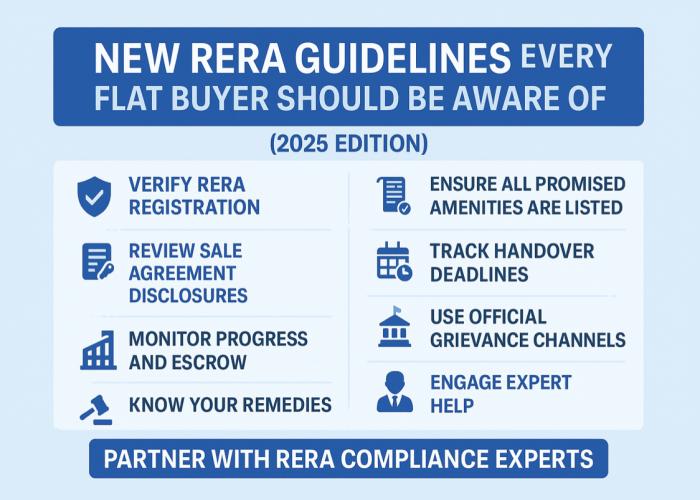
The Real Estate (Regulation and Development) Act, 2016 (RERA) is now the bedrock of homebuyer protection in India. Under RERA, developers must register each project and deposit most buyer funds in an escrow account (at least 70%) for that project . The latest 2024–25 guidelines strengthen this further. For example, MahaRERA’s Order 57/2024 now requires every sale agreement to list all promised amenities (gym, pool, garden, etc.) and their handover dates . This ensures developers clearly communicate project features and timelines to buyers.RERA also enforces tough penalties for delays or defaults. Section 18 of the RERA Act gives buyers the right to exit a project and get a full refund (with interest) if the builder misses possession deadlines . This isn’t just theory: in early 2025, a Karnataka RERA tribunal ordered a builder to return ₹2.56 crore (with interest) to a flat-buyer after a seven-year delay . Likewise, Haryana’s RERA recently held a developer accountable for a decade-long delay, ordering him to refund ₹1.07 crore plus 11.1% interest (total ₹2.26 crore) to the buyer . Builders must also fix structural defects at their own cost for five years after possession, extending warranty protection far beyond older norms.Because of RERA’s enforcement, buyers now see promised homes and amenities materialize more reliably. Developers must commit to fixed delivery dates for every facility – from swimming pools to clubhouses – or face penalties. For instance, Telangana RERA found a Hyderabad project only 20% complete after three years and ordered refunds with 11% interest to all 62 buyers for the delay . Experts note that requiring exact handover dates “adds accountability,” since homebuyers clearly know when to expect each promised feature .Other key safeguards remain in force. By law, 70% of the money you pay to the builder must go only into the RERA-designated account for that project , preventing diversion of funds. Builders cannot advertise or sell flats before RERA approval, and any violations invite penalties or cancellations. Importantly, recent court rulings confirm that homebuyers can pursue remedies under RERA and under consumer-protection laws simultaneously. In short, fraud or delay can no longer be swept under the rug – homebuyers now have multiple legal venues to insist on fair play.While RERA is implemented state-by-state, its core protections are national. In fact, regulators are building a unified national RERA portal to standardize data across all states . Soon, any buyer will log in and see a developer’s entire track record and project status across India. This integrated system will group every project of a builder together (preventing them from hiding bad history under shell entities) . The goal is to give flat buyers one-click access to key project information and quickly flag any non-compliance.Simplified Checklist for Flat Buyers (2025)Verify RERA registration: Always check that your flat’s project and the developer are registered on the state RERA portal. Official RERA websites list project approvals, layout plans and quarterly progress updates. If the builder isn’t RERA-registered, walk away – you lose all legal protection .Review sale agreement disclosures: Confirm the agreement spells out all promised amenities (pool, gym, garden, etc.) and the deadlines for each . New RERA rules require this level of detail. Any major change later needs the consent of two-thirds of homebuyers . If an amenity is promised in marketing, it must be clearly in the contract.Monitor progress and escrow: Ensure 70% of your payments are going into the RERA escrow account (ask the builder or check RERA filings for confirmation). Track construction progress via the RERA portal or status reports. Soon you’ll even be able to use the national RERA platform to compare projects nationwide . Regularly check that the project is meeting its promised milestones.Know your remedies: If possession is delayed, RERA Section 18 guarantees a full refund plus interest on your payments . If you stay invested, you’re entitled to monthly interest for each month of delay. After handover, RERA gives you a 5-year warranty on structural or major defects. Keep all documents and immediately notify the builder (and RERA) of any delays or defects.Use official grievance channels: File a complaint on the RERA portal at the first sign of trouble. State RERAs generally resolve valid cases within a few months once hearings are scheduled. You can also approach a consumer court in parallel. Provide your sale deed, payment receipts and correspondence to strengthen your case.Engage expert help: RERA compliance can be complex for first-time buyers. Consider consulting RERA verification specialists to review the project before booking. Our RERA compliance service can audit the project’s registration, agreements and builder track record against the latest rules. This expert check helps you avoid costly mistakes.Partner with RERA Compliance ExpertsKeeping up with RERA updates and legal paperwork can be daunting. Our firm offers dedicated RERA compliance guidance to simplify the process. We will review all project documents, verify the builder’s RERA registration and ensure every new 2025 guideline is satisfied. We even monitor construction updates and follow up with regulators if needed. By turning a complex legal checklist into step-by-step guidance, we give you peace of mind. With experts on your side, you can confidently move forward with your new home purchase.Key takeaway: RERA 2025 is about transparency and accountability. Use the above checklist before signing any deal. Remember, under RERA delays and omissions now cost the builder – not you – as confirmed by recent rulings . Armed with the latest guidelines and professional support, flat buyers can invest with confidence.Here’s a promotional and lead generation section tailored for your blog article, “New RERA Guidelines Every Flat Buyer Should Be Aware Of (2025 Edition)”, designed to fit seamlessly near the end of the blog and optimized for SEO and conversion:Why Choose KHA ADVOCATES for RERA Compliance & Property Legal Support?At KHA ADVOCATES, we specialize in protecting the rights of NRI clients, first-time homebuyers, and real estate investors across Kolkata, including New Town and Salt Lake. With decades of experience in real estate law, we ensure that your property journey is legally secure, RERA-compliant, and stress-free.Our RERA & Property Legal Services Include:Full RERA Project Verification (West Bengal RERA, pan-India)Sale Agreement & Builder Agreement VettingTracking Escrow & Possession Timeline CommitmentsLegal Due Diligence & Title Search ReportSupport in Filing RERA Complaints & Refund ClaimsRegistration, Stamp Duty, Mutation & HIRA AssistanceWhether you’re booking a ready-to-move apartment in Salt Lake or investing in an under-construction property in New Town, we’ll help you understand:✔ What your builder can and cannot do under RERA✔ Whether your documents meet 2025 legal compliance✔ What your refund or compensation rights are if timelines slip📞 Book a Free Consultation TodayAvoid costly legal pitfalls before you buy. Let KHA ADVOCATES protect your investment with verified property documentation and expert RERA compliance.👉 Call us now : 94-777-5-888-5👉 WhatsApp: 8101-555-666👉 Email us: contact@khaadvocates.in👉 Visit: www.khaadvocates.com👉 Offices: Kolkata | Virtual Consultations for NRIs 🌐🔐 Buying a Flat? The Builder May Promise. We Legally Verify.Stay protected. Stay informed. Partner with KHA ADVOCATES — your trusted legal shield in Indian real estate.
Read More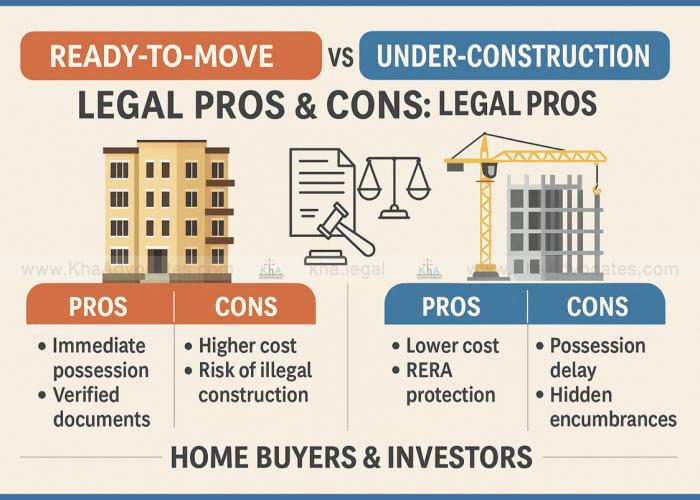
IntroductionBuying a flat is a milestone. But a critical question arises for every buyer:Should you go for a ready-to-move-in flat or an under-construction property?While both options come with distinct advantages, the legal implications, risks, and due diligence steps differ drastically. This blog breaks down the legal pros and cons of both choices—especially for first-time home buyers, real estate investors, and NRIs planning to invest in areas like New Town, Salt Lake, and Kolkata.✅ Ready-to-Move-in Flats: Legal Pros & ConsA ready-to-move-in flat is one where construction is completed, possession is granted, and the buyer can immediately shift in or start renting it out.Legal Advantages of Ready-to-Move Properties1. Clear Title & Immediate PossessionYou get to verify the actual property ownership, completion certificate, occupancy certificate, and municipal approvals.No uncertainty over possession timelines.2. No GSTAs per current tax laws, GST is not applicable on ready-to-move properties that have received Completion Certificate (CC).3. What You See Is What You GetThe buyer can physically inspect the flat, locality, and building condition—making legal verification easier.4. Easier to Conduct Legal Due DiligenceYour lawyer can perform a property title search, verify the chain of ownership, check mutation, and confirm that the flat is free from encumbrances.Legal Disadvantages of Ready-to-Move Properties1. Higher CostPer square foot prices are typically 10–20% higher than under-construction properties.2. Risk of Illegal ConstructionMany “ready” flats, especially in developing zones like New Town and Rajarhat, are illegally built without proper sanction plans. Without legal verification, you risk demolition or penalties.3. No Time to Rectify Legal IrregularitiesOnce you purchase, any pending litigation, land disputes, or illegalities become your burden.🏗️ Under-Construction Flats: Legal Pros & ConsAn under-construction property is still being developed and usually offers staged payment plans and relatively affordable pricing.Legal Advantages of Under-Construction Properties1. Lower Cost with FlexibilityPrice per square foot is often lower, especially during pre-launch stages.Payment plans are staggered across construction milestones, helping with financial planning.2. RERA Registration is MandatoryBuilders must register under RERA (Real Estate Regulation and Development Act). This adds a layer of transparency and legal protection for the buyer.3. Scope for CustomisationBuyers may request minor changes in layout, flooring, or fittings during the construction phase.Legal Disadvantages of Under-Construction Properties1. Possession Delay RiskDespite RERA, delays of 1–2 years are still common, especially in West Bengal where monitoring is lax.2. Developer Fraud or AbandonmentNumerous cases in New Town and Salt Lake Extension areas involve builders collecting funds but failing to deliver.📌 Example: A 2022 Calcutta High Court case involved a Rajarhat builder promising possession within 24 months but defaulting for over 5 years. Buyers had to litigate for refund and interest.3. Hidden Encumbrances on LandBuilders may start projects on land that is disputed, mortgaged, or under acquisition. Without legal due diligence, the buyer’s money is at risk.4. GST Applies5% GST is applicable (without Input Tax Credit) for under-construction flats, adding to the total cost.What Legal Due Diligence Must Be Done—For Both TypesWhether buying ready or under-construction property, the following legal checks are essential:For Ready-to-Move FlatsTitle search report (at least last 30 years)Occupancy Certificate (OC)Completion Certificate (CC)Mutation & Property Tax clearanceChain of documents (including Sale Deed, Conveyance, etc.)Verification of No Dues from Society or BuilderEncumbrance CertificateFor Under-Construction FlatsRERA Registration Number & StatusSanctioned Building PlanCommencement CertificateLand Title Report (verify if land is freehold, residential, and owned by builder)Development Agreement and Power of Attorney of builderAgreement for Sale vetted by legal expertsHow Our Law Firm Can HelpAt KHA ADVOCATES, we’ve assisted hundreds of NRI and first-time buyers in verifying and registering properties across Kolkata. Our services include:1. Property Title VerificationGet a comprehensive title search report with legal opinion—ensuring you don’t invest in disputed or encumbered flats.2. Agreement Drafting & ReviewWe vet or draft Agreement for Sale, Sale Deed, or Builder-Buyer Agreement to protect your interests.3. RERA Compliance & Builder Due DiligenceWe check the track record, RERA filings, and legal standing of the builder and construction status.4. Property Registration SupportOur team handles property registration, stamp duty calculation, and sub-registrar office coordination on your behalf—even without your physical presence.Conclusion: Choose Wisely, LegallyThe choice between ready-to-move and under-construction properties must balance your budget, timeline, and risk appetite. But one thing is non-negotiable—legal due diligence.In Kolkata’s fast-growing property landscape, especially in New Town, Rajarhat, and Salt Lake, blind trust on builders can cost you lakhs. But with the right legal partner, you buy safely, confidently, and profitably.📞Need Legal Help Before Buying a Flat in Kolkata?👉 Book a consultation with our real estate legal experts👉 Call us at 94-777-5-888-5👉 WhatsApp us at 8101-555-666👉 Email: contact@khaadvocates.in👉 Visit: www.khaadvocates.com
Read MoreExplore our range of easy-to-use financial and legal calculators designed to simplify your property and legal decisions. Get quick, accurate estimates for stamp duty, EMIs, area conversions, and alimony calculations.

Our team provides specialized services for loan settlement, ensuring a hassle-free and secure process. We handle negotiations, documentation, and legal formalities to help you settle your loans efficiently.
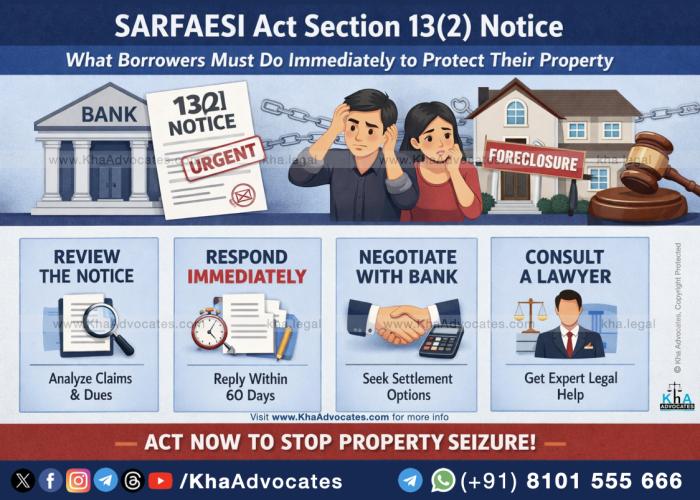
1. IntroductionMany borrowers panic when they receive a notice under SARFAESI Act 2002.A notice under Section 13(2) is the first legal step toward seizure of secured property by banks.Ignoring it can eventually lead to:• property possession• public auction• eviction2. What Is SARFAESI Section 13(2)?Under SARFAESI Act 2002, banks can recover secured loans without filing a civil suit.The 13(2) notice demands repayment within 60 days.If the borrower fails, the bank may proceed to:• possession of property• sale of assets• auction of property3. Timeline After SARFAESI Notice1. 13(2) Notice – 60 days repayment period2. 13(3A) Representation by borrower3. 13(4) Possession notice4. Auction of Property4. Borrower RightsBorrowers have several legal protections:• Right to reply to the notice• Right to challenge illegal action• Right to approach DRT5. Landmark Case LawMardia Chemicals Ltd v. Union of IndiaThe Supreme Court held that borrowers must be given an opportunity to raise objections before banks proceed further.6. How Lawyers Stop Illegal Property SeizureExperienced lawyers often challenge:• defective notices• incorrect loan calculations• violation of procedure7. How KHA Advocates Helps BorrowersAt KHA Advocates, we assist borrowers with:• Drafting legal replies to SARFAESI notices• DRT litigation• Settlement negotiations with banks
Read More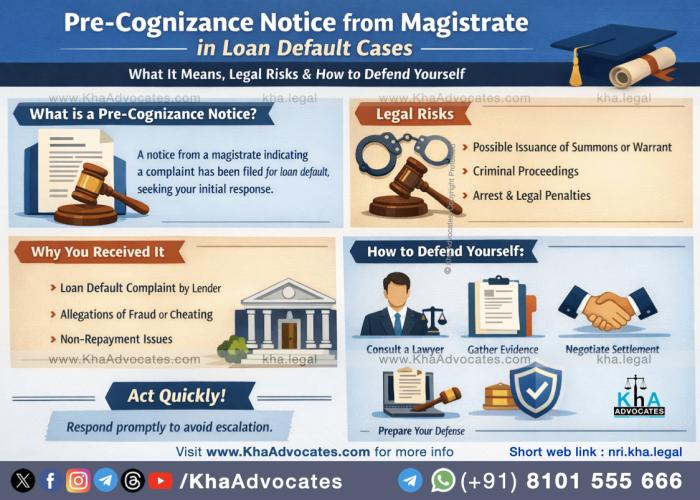
Pre-Cognizance Notice from Magistrate in Loan Default Cases: What It Means, Legal Risks & How to Defend YourselfReceiving a pre-cognizance notice from a Magistrate Court can be one of the most alarming experiences for any borrower. Many people initially assume it is merely another recovery notice from a bank or financial institution. In reality, such a notice indicates that a criminal complaint has already reached the court and the matter is now under judicial scrutiny.Under the modern criminal law framework of India, proceedings before Magistrate Courts are governed by the Bharatiya Nagarik Suraksha Sanhita, while offences such as cheating, fraud, and criminal breach of trust are governed by the Bharatiya Nyaya Sanhita.If you have received a pre-cognizance notice, ignoring it can lead to serious legal consequences, including summons, warrants, attachment of property, or criminal trial.This article explains:• What a pre-cognizance notice means• Why banks and lenders use criminal proceedings• The legal consequences for borrowers• Relevant case laws• Practical defence strategies• How experienced lawyers can protect youWhat Is a Pre-Cognizance Notice from a Magistrate?A pre-cognizance notice is issued by a Magistrate before deciding whether to take formal cognizance of a criminal complaint.Under the Bharatiya Nagarik Suraksha Sanhita, a Magistrate receiving a complaint may:Examine the complainant and witnessesCall for a report or inquiryIssue notice to the accused before taking cognizanceThis stage is extremely important because the court is determining whether sufficient grounds exist to start criminal proceedings.Many borrowers wrongly assume:“Nothing serious will happen because it is only a notice.”In reality, the Magistrate is already examining whether the complaint discloses criminal offences under the Bharatiya Nyaya Sanhita.Why Banks File Criminal Complaints for Loan DefaultLoan default is generally a civil matter. However, banks and NBFCs often file criminal complaints alleging:• Cheating• Fraudulent intention• Criminal breach of trust• Dishonest misrepresentationThese allegations can trigger offences under the Bharatiya Nyaya Sanhita.Financial institutions usually take this step when they believe:• Borrower deliberately avoided repayment• False documents were submitted• Security was disposed of• Cheques were dishonoured• Borrower abscondedOnce a complaint is filed before a Magistrate, the matter enters the criminal justice system.Legal Procedure After a Pre-Cognizance NoticeThe procedure typically unfolds as follows under the Bharatiya Nagarik Suraksha Sanhita:1. Filing of ComplaintThe lender files a complaint before the Magistrate.2. Preliminary ExaminationThe Magistrate examines the complainant.3. Pre-Cognizance InquiryThe court may issue notice to the accused.4. Cognizance by CourtIf the court finds prima facie evidence, it takes cognizance.5. Issuance of SummonsThe accused is directed to appear before the court.6. Non-Appearance ConsequencesFailure to appear can lead to:• Bailable warrants• Non-bailable warrants• Proclamation proceedingsSerious Risks of Ignoring a Pre-Cognizance NoticeMany borrowers make the mistake of ignoring such notices, assuming the dispute is purely financial.This can lead to severe consequences:1. Criminal SummonsThe court may issue summons requiring personal appearance.2. WarrantsIf the accused fails to appear, warrants may be issued.3. Criminal TrialThe borrower may face trial for offences under the Bharatiya Nyaya Sanhita.4. Reputation DamageCriminal proceedings can severely damage:• business reputation• employment prospects• financial credibilityLandmark Case Laws on Criminal Proceedings in Loan Disputes1. Indian Oil Corporation v. NEPC India Ltd.The Supreme Court held that civil disputes should not automatically be converted into criminal cases unless criminal intent exists.This judgment is frequently relied upon by defence lawyers.2. Vesa Holdings v. State of KeralaThe court clarified that cheating requires dishonest intention at the very beginning of the transaction.Failure to repay a loan alone does not constitute cheating.3. Thermax Ltd v. K.M. JohnyThe Supreme Court emphasized that criminal proceedings cannot be used as a pressure tactic in commercial disputes.Real Example of Loan Default LitigationConsider the following common scenario.A business owner takes a ₹25 lakh business loan from an NBFC.Due to financial losses:• EMIs stop• lender issues recovery notices• borrower negotiates but failsEventually the lender files a criminal complaint alleging cheating and fraud.The Magistrate then issues a pre-cognizance notice.At this stage, many borrowers panic because the matter has moved from bank recovery to criminal court.However, with proper legal defence, such cases can often be challenged or dismissed.Legal Defences Available to BorrowersA skilled lawyer can challenge such proceedings in several ways.1. Lack of Criminal IntentOne of the strongest defences is proving that:• the loan was taken genuinely• repayment failure was due to financial distressCourts have repeatedly held that mere breach of contract is not cheating.2. Dispute Is Civil in NatureIf the dispute relates only to repayment, the defence may argue that it should be resolved through:• civil courts• arbitration• recovery proceedings3. Absence of FraudThe complainant must prove:• false representation• dishonest intention• wrongful gainWithout these elements, criminal liability cannot be established.4. Quashing of ComplaintIn appropriate cases, the accused may approach the High Court seeking quashing of the criminal complaint.Common Mistakes Borrowers MakeBorrowers often worsen their situation by making these mistakes:Ignoring Court NoticeFailure to respond can lead to warrants.Appearing Without Legal AdviceImproper statements before the Magistrate can damage the defence.Signing Settlement Without ReviewSome lenders pressure borrowers into unfair settlement terms.Believing Recovery AgentsRecovery agents often exaggerate legal consequences to create fear.Only a qualified advocate can assess the real legal position.Practical Steps If You Receive a Pre-Cognizance NoticeIf you receive such notice, you should immediately:Step 1: Consult a LawyerEarly legal advice can prevent escalation.Step 2: Analyze the ComplaintYour lawyer must carefully examine:• allegations• documents• loan agreementStep 3: Prepare a Legal ResponseA detailed reply may be submitted before the court.Step 4: Challenge the ComplaintIf the allegations are baseless, legal remedies can be pursued.Step 5: Explore SettlementIn some cases, negotiated settlement may be the best option.Why Early Legal Intervention Is CriticalThe pre-cognizance stage is often the best opportunity to stop criminal proceedings.Once the court takes cognizance and issues summons, the process becomes significantly more complex.Early intervention can:• prevent criminal trial• protect reputation• reduce financial exposureHow KHA Advocates Assists Borrowers in Criminal Loan CasesBorrowers facing criminal complaints require lawyers who understand both banking law and criminal procedure.At KHA Advocates, our legal team provides:• strategic defence in Magistrate courts• legal analysis of loan disputes• challenge to false criminal allegations• representation in bail proceedings• High Court petitions for quashing complaintsWith extensive experience in financial dispute litigation, we help clients protect their rights and reputation.Office AddressKHA AdvocatesNew Town, Hatiara DhankalKolkata – 700157West Bengal, IndiaContact Details📞 Phone: +91-9477758886📧 Email: contact@khaadvocates.in🌐 Website: www.khaadvocates.comWhy Choose KHA Advocates?✔ Experienced in Criminal & Financial Litigation✔ Strong Defence in Magistrate Courts✔ Expertise in Loan Default & Banking Disputes✔ Strategic Case Handling to Prevent Arrest & TrialBook an Urgent ConsultationIf you have already received a court notice, every day matters. A delayed response can result in:• Summons• Warrants• Criminal Trial👉 Call now or book a consultation to protect your legal rights immediately.
Read More
Taking out a loan is common in today’s India — whether for education, business, a home or vehicle. But what happens if you default or fall behind on repayments? While banks and lending institutions are legally entitled to recover dues, there’s a clear line between lawful recovery and harassment. This blog explains your rights as a borrower, what the regulatory and judicial safeguards are under the Reserve Bank of India (RBI) and the Supreme Court of India, how defaults affect your credit (for example via TransUnion CIBIL Limited), and how a lawyer specialising in borrower-protection can help you navigate recovery, negotiate with lenders and stop unfair practices.Why this mattersMany borrowers panic when they are contacted by recovery agents or notices arrive. They may feel powerless. But the truth is: you do have rights. And knowing those rights — plus having a strategy for communication, restructuring or settlement — can make a big difference. It’s not just about avoiding trouble, it’s about protecting your dignity, your credit record and your future borrowing capacity.1. What is lawful loan recovery — and what counts as harassment?Lawful recoveryWhen a borrower defaults, banks and NBFCs have the legal right to recover the money secured under contract. This may include: sending notices, calling you, eventually enforcing security (for secured loans) via laws such as the Securitisation and Reconstruction of Financial Assets and Enforcement of Security Interest Act, 2002 (SARFAESI Act) if applicable. For unsecured loans, the lender may initiate civil legal action or arbitration.What amounts to harassment?Harassment arises when recovery steps go beyond legal, ethical and regulatory boundaries. Some examples of prohibited practices under RBI guidelines and court judgments include:Persistent phone calls or visits at odd hours (e.g., before 8 a.m. or after 7 p.m.), or on Sundays/holidays, without your consent. Use of threats, intimidation, muscle power, public shaming or humiliation. Disclosure of your loan default status to your friends, neighbours, colleagues or employer without your consent — thereby breaching your right to privacy and dignity. Visiting your workplace or home unannounced and cut off from the recovery process’s due course. Taking possession of assets without following the statutory steps, or seeking to coerce you into a settlement under threat.In effect: banks & their agents may collect dues, but they must treat the borrower with dignity and follow due process. The RBI’s Fair Practices Code and circulars make this clear. 2. Key regulatory & judicial protections: RBI + Supreme Court guidelinesRBI guidelinesUnder the Fair Practices Code for Lenders and the related Master Circulars, the RBI has advised banks: “in the matter of recovery of loans, the lenders should not resort to undue harassment viz. persistently bothering the borrowers at odd hours, use of muscle power for recovery of loans, etc.” On 12 August 2022, the RBI issued guidelines on outsourcing of financial services (including recovery agents) that stipulate regulated entities (REs) must ensure their agents do not resort to intimidation or harassment of any kind. Recovery agents are typically allowed to contact borrowers only in defined time slots (in many sources 8 a.m. to 7 p.m.) unless otherwise agreed; they must carry ID cards and have an authorisation letter from the bank. Supreme Court / Legal rulingsThe landmark case ICICI Bank Ltd. v. Shanti Devi Sharma (2008) [2008 7 SCC 532] held that banks cannot adopt strong-arm tactics or employ ‘muscle‐men’ for recovery; they must resort to lawful processes for enforcement of security/loan dues. Courts have repeatedly held that the bank is vicariously responsible for the actions of its recovery agents; unlawful acts by agents can attract regulatory and criminal liability. What this means for a borrowerIf you are being harassed by calls outside permitted hours, or by agents using intimidation, you have a remedy.You can approach the bank’s grievance cell, the Banking Ombudsman under the RBI’s scheme, and ultimately consumer forums or courts for relief. Banks failing to adhere can face regulatory actions by the RBI and compensation orders via Ombudsman. 3. The downside: CIBIL / credit bureau impact & longer-term risksEven if you are correct and not being harassed, a default on loan repayments has implications:Your credit score monitored by CIBIL (or other credit bureaus) can drop. Defaults, non-performing assets (NPAs) and settlements reflect in your credit history.If you settle for a lesser amount (one-time settlement) your record may get a “Settled” or “Closed” tag rather than “Paid in full”, which may affect future loan or credit card approvals.Follow-up harassment or asset‐seizure threats are often triggered not because the bank is “mean” — but because they want to recover before the loan becomes an irrecoverable NPA. Early action helps you negotiate better.Lack of awareness can lead to signing away rights or accepting unfavourable terms under pressure, leading to loss of assets or worse credit consequences.So, while you must protect your rights, you should also take a proactive stance: engage with your lender, seek restructuring, negotiate settlement options, and ensure your credit protein stays intact.4. Practical strategies for borrowers – what you should doa) Stay calm and proactive.Don’t ignore default. The earlier you engage the lender, the more options. Contact your loan officer or branch manager, explain your cash-flow issue, and seek a restructure or moratorium if available.b) Document everything.Save messages, call logs, emails from the bank/recovery agent.If a recovery agent visits your home or workplace, record the date, time, their ID, authorisation letter.If the caller is abusive or calls at odd hours, note it down with screenshots or recordings. This becomes evidence if you later file a complaint or legal action.c) Know your rights and set boundaries.You may set and communicate convenient time slots for calls (within 8 a.m.–7 p.m.) and inform the bank in writing.If agents visit without notice or outside reasonable hours, you can object and register a complaint.You can ask for a written representation of the outstanding, ask for settlement/OTS offers, ask for loan restructure options.d) Negotiate settlement or restructure.If your earnings or business situation is disrupted, ask the bank for a one-time settlement (OTS) or restructuring of loan (change term, interest rate, moratorium etc.). A lawyer can help you negotiate favourable terms and draft formal letters to the bank so that the process is transparent.e) Escalate when needed.If bank doesn’t respond to your grievance, approach the Banking Ombudsman via the RBI’s portal.If agents use threats or force, file a police FIR under relevant IPC provisions (for example, criminal intimidation, trespass). In case of major unfair practice, approach consumer court for compensation and injunction against the bank/agent.f) Protect your credit record.Ask the bank to update your account status after settlement. If you are caught unaware, your account might be closed as “Written-off/Settled” which could hamper future loans. Keep CIBIL (or other bureau) updates in mind.5. Role of a lawyer – how legal help enhances your protectionWhen dealings get complicated, you’ll benefit from the assistance of an experienced lawyer – especially one specialising in borrower-rights, bank recovery and consumer protection. Here’s what a lawyer can bring to the table:– Legal assessmentA lawyer will review your loan contract, check whether the lender/recovery agent is following due process, and identify if you have been subjected to unlawful recovery practices or harassment.– Drafting legal notices & lettersRather than informal calls, a lawyer can send a legal notice to the bank or recovery agent outlining violations (harassment, call timings, privacy breach) and calling for redress. This often triggers faster settlement / restructuring offers from the lender.– Negotiation & settlement supportLawyers can negotiate with banks for one‐time settlement, drop or reduce interest/penalties, get formal written confirmation of settlement terms, and ensure that the settlement doesn’t adversely affect your credit history unduly.– Filing complaints & litigationIf harassment continues, the lawyer can guide you in filing a complaint under the Banking Ombudsman Scheme, consumer forum petition or civil suit for damages. They can also help file FIRs where criminal intimidation is involved.– Credit report/correction supportAfter settlement or restructuring, the lawyer can ensure that the lender updates the credit bureau appropriately, and can help in raising disputes/corrections with CIBIL or other agencies if your status is improperly reflected.– Asset-seizure defenceIn the case of secured loans where banks threaten to seize collateral (under SARFAESI or otherwise), a lawyer can challenge unlawful possession, check compliance with notice periods (like 60 days under SARFAESI), represent before DRTs (Debt Recovery Tribunal) and safeguard your property rights. In short: a lawyer adds both a legal shield and a negotiation advantage.6. Summarised checklist for borrowers✅ StepWhat to doWhy it matters1. Understand your loanKnow your EMI amount, interest rate, security (if any), default statusHelps you engage knowledgeably2. Engage the lender earlyContact bank, ask for restructuring, settlement optionsEarly engagement tends to yield better outcomes3. Document all interactionsKeep call logs, agent visits, written communicationEvidence is key if things go wrong4. Check recovery agent conductAre calls between 8 a.m.–7 p.m.? Do they carry ID? Are they avoiding threats?Breach means you can complain5. Know your rightsNo intimidation, no public shaming, privacy must be protectedProtects your dignity, future borrowing6. Approach lawyer when neededGet professional support to negotiate / defend your rightsSignificantly improves negotiating power7. Monitor your credit reportAfter settlement/restructure, check CIBIL or other bureau for correct statusEnsures future loan access is not harmed7. In conclusion: You are not powerlessYes — banks and NBFCs have the right to recover loans. But they cannot disregard your rights. The RBI and Supreme Court guidelines make it clear: recovery must be lawful, respectful, transparent and conducted with dignity. If you face harassment, you have legal recourse. Simultaneously, you must proactively engage with the lender, consider practical solutions like restructuring or one-time settlement, and monitor your credit health. A lawyer who understands borrower-rights can be the difference between being pushed into a disadvantageous settlement and negotiating a workable, dignified outcome.If you’re facing persistent calls, threats or unfair recovery tactics — remember: this is not just stress or part of default. It may be a violation. Document it, engage your bank, and if it continues, seek legal help. Your rights are protected. Your credit and dignity matter.8. When Should You Contact a Lawyer?Reach out to a legal professional if:You’re receiving threat calls or late-night messages.Recovery agents visit your home or workplace repeatedly.You’ve been humiliated publicly or online by agents.You want to negotiate settlement legally to protect your CIBIL score.You’ve received a SARFAESI notice or legal summons.Early legal help prevents escalation and ensures your rights are respected from day one.9. How KHA Advocates Protect BorrowersAt KHA Advocates, we understand that loan recovery disputes can cause stress, confusion, and fear. Our legal team specialises in banking law, borrower protection, and debt resolution strategies.🌐 Our Services Include:Drafting & sending legal notices against recovery harassmentNegotiating loan settlements & restructuring dealsHandling RBI Ombudsman & Consumer Forum casesDefending SARFAESI & DRT matters to protect your propertyHelping update CIBIL / credit bureau records post-settlementOffering confidential consultations for borrowers under pressureEvery case is handled with utmost discretion and legal precision. We aim not only to protect your rights — but to restore your peace of mind and financial dignity.📞 Contact KHA AdvocatesKHA Advocates – Legal Experts in Borrower Protection & Banking Laws📍 Office: New Town, Kolkata 700157📧 Email: contact@khaadvocates.in📱 Phone: +91-9477758885📱 WhatsApp: +91-8101-555-666🌐 Website: www.khaadvocates.com💬 “Legal strength, strategic negotiation, and borrower dignity — that’s what we stand for.”9. Final TakeawayBanks have the right to recover loans — but not the right to harass you.Borrowers have legal protection under RBI & Supreme Court guidelines.If you’re facing unfair recovery practices, remember:You can say no to intimidation.You can complain and take legal action.You can restructure or settle smartly — with the right legal guidance.Whether you need advice, negotiation, or defence — KHA Advocates stands with you.Because every borrower deserves respect, fairness, and lawful recovery.
Read More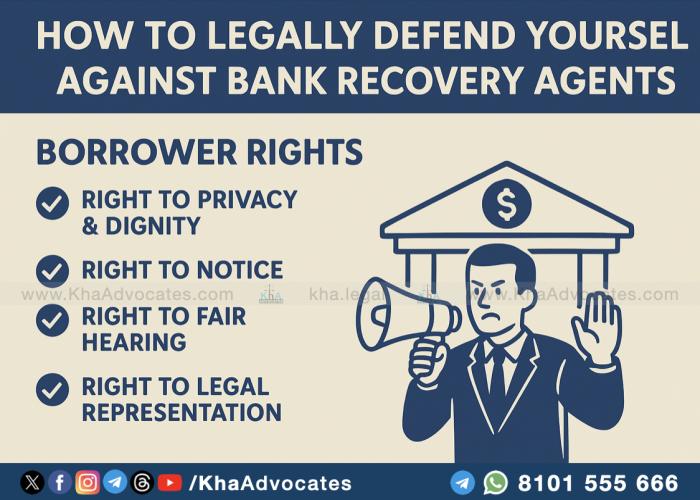
Imagine this: You’re sitting at home with your family when your phone starts buzzing nonstop. Unknown numbers, rude voices, even threats — all coming from bank recovery agents demanding repayment of your overdue loan. The stress feels unbearable. You start wondering — “Do I have no rights at all? Can banks and their agents harass me like this?”The truth is — you DO have rights. Indian law, RBI guidelines, and Supreme Court judgments protect borrowers from harassment. Banks are allowed to recover dues, but not by breaking the law or treating you with indignity.This blog will explain your legal rights against recovery agents, real-life case studies, and how a lawyer can help you settle loans legally while protecting your dignity.The Growing Problem of Loan Recovery HarassmentWith rising personal loans, credit cards, and home loans, many borrowers face repayment difficulties due to job loss, medical emergencies, or financial instability. Unfortunately, instead of offering solutions, some banks employ aggressive recovery agents.Borrowers report:Threat calls late at nightHumiliation at workplace or in front of neighborsUse of abusive language and intimidationUnlawful confiscation of property👉 This not only violates basic human dignity but also goes against Reserve Bank of India (RBI) rules and Supreme Court directions.RBI Guidelines on Loan RecoveryThe Reserve Bank of India (RBI) has clearly laid down rules to prevent harassment:Respectful Conduct – Recovery agents must treat borrowers with dignity, respect, and courtesy.Time Restrictions – Calls/visits are only allowed between 7 AM and 7 PM.Privacy Protection – Agents cannot disclose loan details to neighbors, relatives, or employers.Prohibition of Harassment – No abusive language, intimidation, or threats of violence.Identification Requirement – Recovery agents must carry proper authorization and identity cards.Violation of these rules gives borrowers the right to file a complaint with RBI and take legal action.Supreme Court on Borrower HarassmentThe Supreme Court has repeatedly protected borrowers against illegal recovery practices.🔹 ICICI Bank v. Shanti Devi Sharma (2008)The Court strongly condemned banks using goons for recovery, calling it illegal and unacceptable.🔹 Manager, ICICI Bank v. Prakash Kaur (2007)SC directed that banks must follow the law and cannot use strong-arm tactics.🔹 State Bank of India v. Rajesh Agarwal (2023)SC emphasized borrower protection under the SARFAESI Act, ensuring fair opportunity before action.👉 The consistent message: Banks must recover dues legally, not by harassment.Borrower’s Legal Rights Against Recovery AgentsIf you are being harassed by bank recovery agents, remember these rights:✅ Right to Privacy & Dignity – No harassment at odd hours or public shaming.✅ Right to Notice – Bank must send legal notice before taking action under SARFAESI Act.✅ Right to Fair Hearing – You can approach the Debt Recovery Tribunal (DRT).✅ Right to Complain – File complaints with the bank, RBI, or even police for harassment.✅ Right to Legal Representation – You can hire a lawyer to handle negotiations, restructuring, or settlement.Case Study: Loan Harassment & Legal ReliefCase 1: Credit Card Harassment in KolkataA young IT professional faced repeated late-night calls from recovery agents threatening to inform his employer. With legal intervention, a notice was sent citing RBI guidelines and harassment laws. The bank immediately changed its approach and offered a one-time settlement plan.Case 2: Auto Loan Recovery in MumbaiA family reported that agents forcibly tried to seize their vehicle without notice. The borrower approached the High Court, which ruled in his favor, stating that banks cannot repossess without following due legal process.How a Lawyer Can Protect YouFacing recovery agents alone can be overwhelming. An experienced loan settlement lawyer can:Stop illegal harassment through legal noticesNegotiate with banks for loan restructuring or settlementFile complaints with RBI, Banking Ombudsman, or courtsRepresent you before Debt Recovery Tribunal (DRT)Ensure your rights are safeguarded under RBI & Supreme Court laws👉 At KHA Advocates, we specialize in protecting borrowers from recovery agent harassment and negotiating favorable loan settlements.Steps to Take if Harassed by Recovery AgentsStay Calm & Document EverythingRecord calls, note timings, and save messages.Check AuthorizationAsk recovery agents to show ID cards and bank authorization.Know Your RightsRemember: No harassment after 7 PM, no public humiliation, no threats.Send a Legal NoticeThrough a lawyer citing RBI & Supreme Court guidelines.Negotiate SettlementExplore one-time settlement (OTS) or restructuring options.File ComplaintApproach RBI Banking Ombudsman, police, or court if harassment continues.Why This MattersDebt stress can destroy peace of mind, strain family relationships, and even push borrowers toward depression. Many cases of suicide due to loan recovery harassment have shaken the nation.The law exists to protect you from such tragedies. Banks have the right to recover money, but only legally, respectfully, and within the framework of justice.Final ThoughtsIf you’re struggling with loan repayment and facing harassment, remember: You are not powerless. Indian law is on your side.Banks can recover loans, but not at the cost of your dignity.RBI and Supreme Court have clearly drawn boundaries.With the right legal guidance, you can settle loans without harassment.📞 Need Legal Help with Loan Recovery Harassment?At KHA Advocates, we specialize in protecting borrowers’ rights against unlawful recovery practices by banks and agents. Our expert team helps you with:Loan settlement negotiationsLegal notices & representationFiling complaints against harassmentCourt protection under RBI & Supreme Court guidelines📍 Office Address:KHA Advocates, New Town, Hatiara, Dhankal, near City Centre 2 & Baguiati, Kolkata 700157📧 Email: contact@khaadvocates.in📱 Phone : +91-9477758885📱 WhatsApp : +91-8101555666🌐 Website: https://khaadvocates.com/services/loan-settlement👉 Don’t suffer in silence. Contact us today for a confidential consultation.
Read More
Introduction: The Hidden Struggle of BorrowersImagine this—Rahul, a young IT professional from Bangalore, takes a personal loan to manage his wedding expenses. A year later, unexpected medical bills and job uncertainty make it impossible for him to pay EMIs on time. Instead of empathy, he receives daily harassment calls from recovery agents—sometimes late at night, sometimes at his office. His mental peace shatters.If this sounds familiar, you’re not alone. Thousands of borrowers in India face similar situations every day. The good news? Banks cannot harass you for loan recovery. RBI and the Supreme Court have laid down clear rules to protect borrowers. If you know your rights, you can stand strong against illegal practices.This blog will explain your legal rights, RBI rules, Supreme Court judgments, and how expert lawyers can help you settle loans legally without harassment.1. Understanding Loan Recovery in IndiaBanks and NBFCs have the right to recover loans, but the method must be fair, transparent, and lawful. Recovery agents cannot use threats, intimidation, or public humiliation.The Reserve Bank of India (RBI) regulates how banks can approach borrowers. The Supreme Court of India has also issued strict warnings against coercive recovery tactics.Yet, in reality, borrowers are often:Harassed with repeated calls at odd hoursThreatened with property seizure without proper legal noticeHumiliated in front of family or workplaceMentally tortured, leading to stress, anxiety, even suicidesThis is not just unethical—it’s illegal.2. RBI Guidelines on Loan RecoveryThe RBI has issued multiple circulars on recovery practices. Here’s what borrowers must know:✅ No Harassment Calls: Recovery agents can contact you only between 7:00 AM and 7:00 PM.✅ Proper Identity: Agents must carry valid IDs and authorization letters.✅ Privacy Protection: They cannot humiliate you at work or disclose your debt to friends/family.✅ No Physical Force: Threats, abuse, or physical harm are strictly prohibited.✅ Written Notice: Before initiating recovery, banks must send a proper written notice.✅ Right to Fair Settlement: Borrowers have the right to negotiate settlement terms legally.👉 If these rules are violated, you can file a complaint with the RBI, Banking Ombudsman, or take legal action.3. Supreme Court Judgments on Loan Recovery HarassmentThe Supreme Court has repeatedly condemned aggressive recovery practices.ICICI Bank v. Shanti Devi Sharma (2008): The Court held banks accountable for using goons and coercion, stating that such practices violate human rights.Manager, ICICI Bank v. Prakash Kaur (2007): SC directed banks to stop employing musclemen for loan recovery.Axis Bank v. State of Punjab (2016): The Court warned that unlawful recovery methods can attract criminal charges.📌 These judgments reinforce one truth: Banks must recover loans legally, not by harassment.4. Borrower’s Legal Rights You Must KnowIf you are facing harassment, remember:🔹 Right to Dignity: No one can insult or threaten you for non-payment.🔹 Right to Privacy: Your financial situation cannot be publicly disclosed.🔹 Right to Legal Notice: Banks must serve a proper notice before any recovery action.🔹 Right to Fair Settlement: You can approach banks for one-time settlement (OTS) or restructuring.🔹 Right to Complain: File complaints with RBI Ombudsman, police, or consumer forum if harassed.5. Case Study: From Harassment to Legal ReliefCase Example:Priya, a small business owner from Delhi, defaulted on her business loan during COVID-19. Recovery agents visited her shop daily, threatening to seize goods.She approached a legal team specializing in loan settlement services. The lawyers:Sent a legal notice to the bank stopping harassmentNegotiated a one-time settlement at 40% lesser paymentProtected her from illegal seizureToday, Priya is debt-free and running her business with confidence.👉 This shows that legal support can transform financial struggles into fresh starts.6. What You Should Do If Harassed by BanksIf banks or agents cross the line, take these steps:Stay Calm, Don’t React: Avoid verbal fights or signing anything under pressure.Document Everything: Record calls, keep notices, and save SMS/emails.File a Complaint: Write to the bank’s grievance cell → RBI Ombudsman → Police (if threats).Seek Legal Help: A loan settlement lawyer can negotiate, protect your rights, and stop harassment immediately.7. How Loan Settlement Legal Services Help YouLoan disputes can feel overwhelming, but with expert legal help, you can:✔️ Stop harassment from recovery agents✔️ Negotiate a lower one-time settlement✔️ Restructure your loan legally✔️ Protect your property from illegal seizure✔️ File cases against banks violating RBI guidelinesAt KHA Advocates, we specialize in loan settlement and borrower protection cases. Our team has helped individuals and businesses reduce debt, stop harassment, and rebuild financial freedom.8. You’re Not AloneDebt can make you feel cornered—but remember, you are not alone. Many honest borrowers face temporary hardships due to job loss, medical expenses, or market slowdown. That doesn’t make you a criminal.Banks must follow the law. If they harass you, the law is on your side.Conclusion: Protect Your Rights, Reclaim Your PeaceBanks have the right to recover money, but not by violating your dignity. RBI guidelines and Supreme Court judgments make it clear—harassment is illegal.If you’re facing harassment, don’t suffer in silence. Take legal action, negotiate your loan legally, and rebuild your life with confidence.📞 Contact Us Now👉 Facing bank harassment for loan recovery? Know your rights and get legal help today.Contact KHA Advocates for expert Loan Settlement Legal Services.🌐 Visit: www.khaadvocates.com/loan-settlement📩 Book a Consultation Now
Read More
IntroductionFacing trouble repaying a loan? You’re not alone. With rising interest rates, job uncertainties, and business disruptions, many individuals and entrepreneurs across India—including NRIs—are exploring loan settlement as a way out of financial stress. But settling a loan isn’t just a financial decision—it has serious legal, tax, and credit score implications.In this guide, we’ll break down the legal process, real-life examples, common mistakes, and how KHA Advocates can help you settle your loans smartly, safely, and legally.What Is Loan Settlement?Loan settlement refers to negotiating with the lender to accept a lower amount than what is due as a full and final payment—typically after a borrower has defaulted and cannot repay in full.📝 Example: If your outstanding loan is ₹8 lakhs and you negotiate a settlement at ₹5 lakhs, the bank may agree, mark your loan as “settled” in the credit bureau, and close the case.⚠️ Important: Settlement is different from loan closure. Settlement negatively affects your CIBIL score and can restrict future borrowing.Legal Process for Loan Settlement in IndiaDefault Notice by the LenderAfter 90 days of non-payment, your loan is classified as an NPA (Non-Performing Asset).Bank sends a legal notice or demand notice.Negotiation PhaseYou or your lawyer negotiates a lump-sum or structured repayment with a waiver of interest or penalties.Settlement AgreementA written agreement (with legal terms) is signed between both parties.Ideally vetted or drafted by a lawyer to protect you from future claims.Loan Closure Letter & CIBIL UpdateBank issues a “No Dues Certificate”.CIBIL report marks the account as “Settled” (not “Closed”), impacting credit score.Real Case ExampleMr. Roy, a startup founder in New Town, Kolkata, defaulted on a ₹12L business loan due to COVID-related losses. After months of harassment by collection agents, our team at KHA Advocates negotiated a settlement at ₹7.2L, with a written waiver of interest and legal claims. We also ensured that no criminal or civil case could be reopened post-settlement.Impact of Loan Settlement on Credit ScoreYour CIBIL/Experian score may drop by 75–100 points.“Settled” status remains for 7 years on your credit history.Future loan approvals (especially home or business loans) become harder.💡 Tip: Get legal advice before signing a settlement offer. Many borrowers unintentionally admit liability that can backfire.✅ Pros and Cons of Loan SettlementProsConsQuick debt reliefDamages credit scoreMay save on interestLegal risks if poorly documentedAvoids long litigationReduces future loan eligibilityPsychological peaceCannot reverse once signedMistakes to Avoid During Loan SettlementSettling without a written agreement.Accepting calls from unauthorized recovery agents.Paying partial amounts without legal terms.Ignoring credit score impact.Failing to document No Dues Certificate.Believing verbal promises from bank officials.Settling without legal vetting—risking future litigation.How KHA Advocates Can Help YouWe offer full legal assistance in loan settlement across West Bengal, including Kolkata, New Town, Salt Lake, Baharampur, Hooghly, Alipore, Durgapur, Siliguri, and more.Here’s how we support you legally:Bank/Recovery Agent NegotiationDrafting & Reviewing Settlement AgreementsEnsuring Legal Immunity Post-SettlementPreventing Coercion or HarassmentVerifying CIBIL Record & CleanupAdvising on Alternatives (Restructuring, OTS, SARFAESI)Protecting Your Personal & Business AssetsLoan Settlement Checklist✅ Check loan classification (NPA or not)✅ Calculate total dues (principal + interest + penalties)✅ Decide repayment capacity✅ Consult legal advisor✅ Negotiate with written documentation✅ Avoid verbal assurances✅ Ask for No Dues Certificate✅ Monitor credit report✅ Ensure tax compliance (loan waivers may be taxable)FAQsQ1: Can a lawyer settle a loan on my behalf?✅ Yes. A lawyer can formally represent you and negotiate better terms while protecting your legal rights.Q2: Can banks take legal action after settlement?❌ Not if the agreement is properly drafted and legally closed.Q3: Is loan settlement available for home loans?✅ Yes, but consequences on credit and future eligibility should be weighed carefully.Q4: Will settlement affect my co-applicant or guarantor?✅ Yes, they can also be impacted legally and financially unless specifically released in writing.Q5: Can I remove “settled” status from my CIBIL report?⚠️ It stays for 7 years. In some cases, our firm can help file corrections or restructure repayment terms to upgrade status.Why Choose KHA Advocates for Loan Settlement?8+ Years of Legal ExpertiseFast & Ethical Debt NegotiationReal-Time Legal Shield from Harassment100% Confidential ConsultationCustom Strategy for NRIs & BusinessesProven Track Record Across Banks & NBFCsAffordable, Transparent FeesPAN India & Bengal-Focused Support📞 Facing loan stress or recovery threats? Don’t risk it alone.Get expert legal help from KHA Advocates to settle your loan safely, smartly, and legally.👉 Book a FREE Consultation Now | 📧 contact@khaadvocates.in | 📍 Serving Pan India.
Read More
Repaying a loan is a significant financial milestone. However, the journey doesn’t end with the final payment. Ensuring you collect all pertinent documents post-repayment is crucial to safeguard your financial interests and legal rights. This guide outlines the essential documents you should collect after loan repayment, incorporating the Reserve Bank of India’s (RBI) guidelines and relevant legal considerations.📄 1. No Objection Certificate (NOC)The NOC is a formal declaration from the lender stating that you’ve repaid the loan in full and that there are no outstanding dues. This document is vital as it serves as proof of loan closure and is often required for future financial transactions or legal purposes.🏠 2. Original Property DocumentsIf you’ve taken a secured loan, such as a home loan, the bank would have retained original property documents as collateral. Post-repayment, it’s imperative to retrieve:• Title deeds• Sale agreements• Property tax receipts• Encumbrance certificates These documents are essential for establishing ownership and for any future property transactions.🔓 3. Lien Release LetterA lien is a legal claim or right against a property. Upon loan repayment, the bank should provide a lien release letter, confirming that the lien on your property has been removed. This is crucial for updating property records and ensuring clear ownership. 📑 4. Loan Account StatementRequest a comprehensive loan account statement detailing all transactions, including:• EMI payments• Interest charges• Penalties (if any)• Final settlement details This statement serves as a financial record and can be useful for tax purposes or future financial planning.🧾 5. Post-Dated Cheques (PDCs) and ECS DeactivationIf you’ve provided PDCs or set up Electronic Clearing Service (ECS) mandates for EMI payments, ensure:• Retrieval of any unused PDCs• Deactivation of ECS mandatesThis prevents any unintended debits from your account post-loan closure. 🚗 6. Form 35 (For Vehicle Loans)For vehicle loans, the bank registers a hypothecation on your vehicle’s Registration Certificate (RC). Post-repayment, collect Form 35 and the NOC from the bank to remove the hypothecation from the RC at the Regional Transport Office (RTO).📊 7. Updated Credit ReportAfter loan closure, obtain your credit report from credit bureaus like CIBIL, Experian, or Equifax to ensure:• The loan is marked as ‘Closed’• There are no outstanding duesA clean credit report is essential for maintaining a good credit score and for future loan approvals.🏛️ RBI Guidelines on Document ReturnThe RBI has mandated that banks and Non-Banking Financial Companies (NBFCs) must return all original movable or immovable property documents within 30 days of full loan repayment. Key Points:• Timeline: 30 days from the date of loan closure.• Penalty for Delay: Banks are liable to pay ₹5,000 per day for delays beyond the stipulated period.• Loss or Damage: In case of loss or damage to original documents, banks must assist borrowers in obtaining certified duplicates within 30 days. ⚖️ Legal ConsiderationsIt’s essential to be aware of your legal rights concerning loan closure:• Equity of Redemption: As established in the case of Vernon v Bethell, borrowers have the right to reclaim their property upon full repayment of the loan.• Right to Information: Under the Right to Information Act, borrowers can request information regarding their loan accounts and related documents. ✅ ConclusionCollecting all relevant documents after loan repayment is not just a procedural formality but a crucial step in ensuring your financial and legal security. Adhering to RBI guidelines and understanding your rights can help you navigate this process smoothly.Always maintain both physical and digital copies of these documents for future reference.For more insights on financial management and legal rights, stay tuned to our blog.
Read More


We simplify property purchases in India for NRIs, handling paperwork, property checks, and legal issues. We ensure a smooth buying process.









Tailored legal solutions for builders and developers, ensuring compliance and successful project completion.

IntroductionBuying your dream home is one of the biggest financial and emotional decisions of life. Many buyers, especially first-time buyers, are drawn towards under-construction flats or apartments because they are often cheaper than ready-to-move-in properties and come with flexible payment options. However, under-construction properties also involve higher risks, such as project delays, legal disputes, or even fraud.As a buyer, knowing the legal process, safety measures, and essential do’s & don’ts can help you secure your investment and avoid unnecessary stress.At KHA Advocates, we assist property buyers with end-to-end legal support, from due diligence to registration, ensuring you buy your home with complete confidence.Step-by-Step Legal Process of Buying an Under-Construction Flat1. Check RERA RegistrationVisit your state’s RERA (Real Estate Regulatory Authority) portal.Verify whether the project is registered.Check the builder’s past projects, timelines, and compliance status.👉 Why it matters: Only RERA-approved projects provide legal safeguards for buyers.2. Verify Builder’s Title & ApprovalsConfirm the builder has clear ownership or development rights over the land.Check approvals from local authorities (municipality, fire, environmental clearance, etc.).👉 Why it matters: Buying from a builder without proper approvals can lead to cancellation of the project.3. Examine the Builder-Buyer AgreementCarefully review clauses on possession date, construction linked payments, cancellation, and refund policies.Look for hidden charges (maintenance, parking, club membership, etc.).👉 Why it matters: This agreement defines your rights – a lawyer can help negotiate unfavorable terms.4. Payment & Home Loan ProcedurePayments should follow the construction-linked plan and not exceed 10% before agreement registration (as per RERA).For home loans, banks conduct their due diligence – but don’t rely solely on bank approvals.5. Registration of Agreement for SaleLegally register your agreement at the Sub-Registrar’s office.Pay applicable stamp duty & registration charges.6. Possession & Occupancy CertificateBefore possession, check for Occupancy Certificate (OC) and Completion Certificate (CC).Without these, the property is legally incomplete.Safety Measures Before Booking an Under-Construction Flat✅ Check Builder’s Reputation – Past delays, litigation, financial standing.✅ Verify Carpet Area – RERA mandates selling on carpet area, not super built-up.✅ Escrow Account Compliance – Ensure builder deposits 70% of buyer’s funds in RERA account.✅ Timely Updates – RERA requires builders to provide construction progress updates online.✅ Legal Scrutiny of All Documents – Hire a property lawyer to verify every paper.Do’s & Don’ts List for Buyers✅ Do’s:Do verify the project’s RERA registration.Do conduct a legal title check of the land.Do hire a real estate lawyer for document vetting.Do keep all receipts, agreements, and builder communication in writing.Do check for hidden charges like GST, maintenance, parking.❌ Don’ts:Don’t rely solely on the builder’s brochure or promises.Don’t pay more than 10% of the cost before agreement registration.Don’t skip checking OC & CC before taking possession.Don’t ignore the fine print in the builder-buyer agreement.Don’t book based only on verbal assurances or flashy advertisements.Case Study: Buyers Saved by Legal Due DiligenceA group of buyers in Kolkata booked flats in an under-construction project that was heavily advertised. Our team at KHA Advocates was approached for due diligence. Upon inspection, we found that:The land title had a pending litigation.The builder had failed to secure environmental clearance.By acting early, the buyers avoided investing in a risky project and redirected their funds into a RERA-compliant development.👉 Lesson: A small investment in legal checks can save you from losing your life savings.Why You Need a Real Estate Lawyer for Under-Construction PropertiesContract Protection – Lawyers help negotiate builder-buyer agreements to protect your interests.Fraud Prevention – Prevents scams by verifying builder credentials and land titles.Compliance Checks – Ensures approvals and sanctions are in place.Dispute Resolution – Quick legal recourse in case of delays or defaults.Peace of Mind – Focus on your dream home while your lawyer safeguards your investment.ConclusionBuying an under-construction flat can be rewarding, but it comes with risks that only expert legal guidance can minimize. Don’t let hidden clauses, delayed possession, or fraud turn your dream home into a nightmare.At KHA Advocates, we specialize in property law and real estate legal services. From document verification to dispute resolution, we ensure that your home-buying journey is secure, transparent, and stress-free.👉 Build your dream home with confidence – Partner with KHA Advocates today!📞 Contact Us: +91-9477758885📧 Email: contact@khaadvocates.in📍 Location: New Town, Near CC2, Kolkata, West Bengal, India🌐 Visit: www.khaadvocates.com
Read More
IntroductionThe real estate industry is one of the most lucrative yet legally complex sectors in India. Every deal—whether it’s the purchase of land, the sale of flats, or large-scale township development—comes with a web of contracts, regulatory approvals, and compliance obligations. For real estate agents and developers, success is not just about finding the right buyer or executing a project; it’s about ensuring that every step is legally secure.This is why having an expert real estate lawyer on your side is no longer optional—it is a necessity. At KHA Advocates, we specialize in providing end-to-end legal solutions to real estate agents, developers, and investors, ensuring smooth transactions, risk mitigation, and faster deal closures.Why Real Estate Lawyers Are Indispensable1. Property Title Verification & Due DiligenceBefore finalizing any property deal, it is crucial to verify ownership and legal status.Our lawyers conduct title searches, encumbrance checks, mutation record verification, and litigation status checks.This ensures that developers and agents never risk selling or promoting disputed properties.2. Drafting & Reviewing AgreementsReal estate transactions involve Agreements to Sell, Sale Deeds, Development Agreements, Lease Deeds, RERA-compliant builder-buyer agreements, and Joint Venture Contracts.A minor error in drafting can lead to years of litigation or financial loss.Our expert lawyers ensure every clause safeguards your interest, prevents disputes, and complies with Indian property law.3. RERA Compliance & Regulatory ApprovalsWith the introduction of RERA (Real Estate Regulatory Authority), developers must comply with stringent guidelines before advertising or selling projects.We assist in RERA registration, quarterly compliance, buyer dispute defense, and regulatory filings.Real estate agents and developers who work with us avoid penalties, project delays, and reputational risks.4. Dispute Resolution & Litigation SupportProperty disputes are common—ranging from delayed possession claims, land acquisition disputes, buyer complaints, or contractual disagreements.Our legal team represents clients before RERA, Consumer Courts, Civil Courts, High Courts, and Arbitration Tribunals.Having a strong legal partner ensures disputes are handled strategically and quickly, protecting your brand reputation.5. Taxation & Financial StructuringReal estate transactions are heavily taxed through stamp duty, GST, TDS, and capital gains tax.Our lawyers collaborate with tax experts to structure deals in the most tax-efficient way, ensuring compliance while maximizing profits.6. Joint Ventures & Builder CollaborationsMany developers enter into Joint Development Agreements (JDAs) with landowners.Without proper legal safeguards, developers risk losing control or profits.Our team ensures fair drafting, profit-sharing clarity, exit clauses, and dispute resolution mechanisms in such collaborations.7. Faster Deal Closures with Legal BackupA property deal backed by a reputed law firm builds trust among buyers, investors, and financial institutions.When buyers see that all documents are vetted by KHA Advocates, confidence increases, leading to quicker sales and project funding.Why Real Estate Agents & Developers Prefer KHA Advocates✅ End-to-End Support – From due diligence to litigation defense.✅ RERA Specialists – Complete compliance support.✅ Deal Structuring Experts – Tax-efficient, legally sound transactions.✅ Strong Dispute Defense – Representation across courts and tribunals.✅ Trusted by Investors & Homebuyers – Our legal certification enhances credibility.Example Case StudyA leading developer in Kolkata faced a buyer dispute over delayed possession. The case went to RERA, where the buyer demanded refund with interest. By strategically defending the matter, KHA Advocates helped the developer avoid a ₹2 crore liability and negotiated an amicable settlement, saving both reputation and money.ConclusionIn today’s competitive real estate market, having an expert real estate lawyer is not a luxury—it’s a business strategy. From compliance to dispute resolution, lawyers ensure that every deal is legally sound, every agreement is enforceable, and every project runs without costly interruptions.At KHA Advocates, we pride ourselves on being the legal backbone for real estate agents and developers, empowering them to focus on growth while we safeguard their legal interests.Let's Connect with an Expert👉 Are you a real estate agent or developer looking for a trusted legal partner?👉 Do you want hassle-free deal closures, RERA compliance, and dispute protection?📞 Contact KHA Advocates today and let our expert real estate lawyers secure your deals.
Read More
IntroductionBuying a property—especially for NRIs or first-time buyers in West Bengal—is often seen as a milestone achievement. However, what’s not visible in glossy brochures and site visits are the hidden charges that can inflate your cost by lakhs. Whether you’re eyeing a premium flat in Salt Lake or an investment property in Durgapur, knowing what lies beneath the surface is crucial to avoid legal and financial pitfalls.At KHA ADVOCATES, we’ve helped hundreds of clients legally uncover and prevent hidden property costs through rigorous legal due diligence, title search, and registration support.⚠️ Common Hidden Charges Most Buyers Overlook1. Legal Scrutiny & Title Due Diligence (Or Lack Thereof)Builders often charge legal processing fees, but these do not include independent title verification. Many NRIs assume the property is “clear,” only to later face disputes.Real Case: A buyer in New Town discovered, post-payment, that the property was under litigation despite having paid legal fees to the builder.✔️ Solution: Always appoint your own property lawyer for due diligence.2. GST on Under-Construction PropertyAs per current law, under-construction properties attract 5% GST (without ITC), while ready-to-move flats are exempt if the completion certificate is received.💡 Tip: Ask for the CC or OC (Occupancy Certificate) to avoid unnecessary tax burdens.3. Car Parking ChargesParking isn’t “free.” Many builders in Kolkata and Salt Lake charge ₹2–6 lakhs for open or covered parking, despite Supreme Court rulings stating parking cannot be sold separately from the flat.📜 Case Reference: Nahalchand Laloochand Pvt Ltd v. Panchali Co-op Housing Society Ltd – SC held that open parking cannot be sold as an independent unit.4. Clubhouse & Maintenance DepositsThese are often presented vaguely as “amenities charges.” In gated communities, builders demand 1–3 years of advance maintenance and non-refundable clubhouse development fees.✔️ Ask for a breakup of maintenance charges and get it in writing.5. Advance Registration ChargesSome developers insist on upfront registration payments. But beware—many delay handing over sale deeds or register in builder’s name first, forcing resale to buyer with double registration fee.✔️ Registration should only happen after OC/CC and full payment clearance.6. Hidden Floor Rise ChargesEven within the same building, rates differ per floor. Builders in Durgapur, Salt Lake, and Alipore may add ₹20–₹100/sqft for “floor rise” without disclosing this early.7. PLC – Preferential Location ChargesCorner flats, park-facing units, or east-facing homes may have added costs. These are negotiable but often hidden until agreement.✔️ Ask early about PLCs. Always include a clause to limit variation in final price.8. Delayed Possession Penalties SkippedAgreements often don’t mention compensation if possession is delayed. Or worse, they include one-sided clauses favoring the builder.📜 RERA mandates a fixed timeline and penalty for delay under West Bengal Housing Industry Regulation Act (WBHIRA).Legal Checklist to Avoid Hidden Charges✅ StepWhat You Must Check🔍 Title VerificationIndependent search of 30+ years of ownership📜 Agreement ClausesClear breakup of GST, PLC, parking, and maintenance🏗️ RERA RegistrationEnsure property is registered on WBHIRA portal🧾 All-Inclusive QuotationAvoid “base price” traps—ask for final cost🖋️ Builder-Buyer AgreementLegally vetted, RERA-compliant contract🧑⚖️ Legal OpinionHire a property lawyer—not builder’s panel advocatePros and Cons: Ready-to-Move vs Under-Construction in West BengalFeatureReady-to-MoveUnder-ConstructionGST✅ No GST❌ 5% GST (no ITC)Hidden ChargesFewerMany (Amenities, Floor rise, PLC)Risk of DelayMinimalHigh without strong contractRegistration TimelineImmediatePost-completionLegal SecurityHighMedium (depends on due diligence)Real-Life Case Study – How Legal Help Saved a Homebuyer ₹5.5 LakhsA client from Baharampur booked a flat in Chinsurah and was asked to pay ₹3 lakhs as “advance clubhouse charges” and ₹2.5 lakhs for “parking rights.” Our legal team reviewed the documents and found both charges illegal under WBHIRA and Supreme Court guidelines. After a formal notice, the builder dropped all additional demands.✔️ Result: Buyer saved ₹5.5 lakhs and got clean registration within 30 days.Frequently Asked Questions (FAQs)Q1: Can I refuse to pay parking charges to a builder?Yes, especially if it’s for open parking. Covered parking may be charged nominally but must be included in the sale agreement.Q2: Are these hidden charges legal under RERA/WBHIRA?No. Builders are mandated to disclose all charges up front. Any deviation can be challenged before the WBHIRA authority.Q3: What if the builder delays possession after I’ve paid full amount?Under RERA, you’re entitled to interest compensation or withdrawal with refund. Get a lawyer to enforce this through legal notice or complaint.Why Choose KHA ADVOCATES?Whether you are an NRI, first-time buyer, or investor, our legal team offers:✅ Title Verification & Search Report (30+ Years)✅ Sale Agreement & Deed Drafting✅ Builder-Buyer Agreement Vetting✅ Registration Support across West Bengal✅ RERA Dispute Handling & Legal NoticesWe’ve helped over 100 clients across New Town, Kolkata, Hooghly, Siliguri, and Durgapur avoid hidden traps and legally secure their investment.ConclusionHidden charges aren’t just financial nuisances—they can become legal nightmares. If you’re buying a property in New Town, Salt Lake, Baharampur, or anywhere in West Bengal, make sure your investment is protected with the right legal guidance.Ready to Buy Property in West Bengal?📞 Book a Legal Consultation with KHA ADVOCATES👉 Call us now : 94-777-5-888-5👉 WhatsApp: 8101-555-666👉 Email us: contact@khaadvocates.in👉 Visit: www.khaadvocates.com
Read More
The Real Estate (Regulation and Development) Act, 2016 (RERA) is now the bedrock of homebuyer protection in India. Under RERA, developers must register each project and deposit most buyer funds in an escrow account (at least 70%) for that project . The latest 2024–25 guidelines strengthen this further. For example, MahaRERA’s Order 57/2024 now requires every sale agreement to list all promised amenities (gym, pool, garden, etc.) and their handover dates . This ensures developers clearly communicate project features and timelines to buyers.RERA also enforces tough penalties for delays or defaults. Section 18 of the RERA Act gives buyers the right to exit a project and get a full refund (with interest) if the builder misses possession deadlines . This isn’t just theory: in early 2025, a Karnataka RERA tribunal ordered a builder to return ₹2.56 crore (with interest) to a flat-buyer after a seven-year delay . Likewise, Haryana’s RERA recently held a developer accountable for a decade-long delay, ordering him to refund ₹1.07 crore plus 11.1% interest (total ₹2.26 crore) to the buyer . Builders must also fix structural defects at their own cost for five years after possession, extending warranty protection far beyond older norms.Because of RERA’s enforcement, buyers now see promised homes and amenities materialize more reliably. Developers must commit to fixed delivery dates for every facility – from swimming pools to clubhouses – or face penalties. For instance, Telangana RERA found a Hyderabad project only 20% complete after three years and ordered refunds with 11% interest to all 62 buyers for the delay . Experts note that requiring exact handover dates “adds accountability,” since homebuyers clearly know when to expect each promised feature .Other key safeguards remain in force. By law, 70% of the money you pay to the builder must go only into the RERA-designated account for that project , preventing diversion of funds. Builders cannot advertise or sell flats before RERA approval, and any violations invite penalties or cancellations. Importantly, recent court rulings confirm that homebuyers can pursue remedies under RERA and under consumer-protection laws simultaneously. In short, fraud or delay can no longer be swept under the rug – homebuyers now have multiple legal venues to insist on fair play.While RERA is implemented state-by-state, its core protections are national. In fact, regulators are building a unified national RERA portal to standardize data across all states . Soon, any buyer will log in and see a developer’s entire track record and project status across India. This integrated system will group every project of a builder together (preventing them from hiding bad history under shell entities) . The goal is to give flat buyers one-click access to key project information and quickly flag any non-compliance.Simplified Checklist for Flat Buyers (2025)Verify RERA registration: Always check that your flat’s project and the developer are registered on the state RERA portal. Official RERA websites list project approvals, layout plans and quarterly progress updates. If the builder isn’t RERA-registered, walk away – you lose all legal protection .Review sale agreement disclosures: Confirm the agreement spells out all promised amenities (pool, gym, garden, etc.) and the deadlines for each . New RERA rules require this level of detail. Any major change later needs the consent of two-thirds of homebuyers . If an amenity is promised in marketing, it must be clearly in the contract.Monitor progress and escrow: Ensure 70% of your payments are going into the RERA escrow account (ask the builder or check RERA filings for confirmation). Track construction progress via the RERA portal or status reports. Soon you’ll even be able to use the national RERA platform to compare projects nationwide . Regularly check that the project is meeting its promised milestones.Know your remedies: If possession is delayed, RERA Section 18 guarantees a full refund plus interest on your payments . If you stay invested, you’re entitled to monthly interest for each month of delay. After handover, RERA gives you a 5-year warranty on structural or major defects. Keep all documents and immediately notify the builder (and RERA) of any delays or defects.Use official grievance channels: File a complaint on the RERA portal at the first sign of trouble. State RERAs generally resolve valid cases within a few months once hearings are scheduled. You can also approach a consumer court in parallel. Provide your sale deed, payment receipts and correspondence to strengthen your case.Engage expert help: RERA compliance can be complex for first-time buyers. Consider consulting RERA verification specialists to review the project before booking. Our RERA compliance service can audit the project’s registration, agreements and builder track record against the latest rules. This expert check helps you avoid costly mistakes.Partner with RERA Compliance ExpertsKeeping up with RERA updates and legal paperwork can be daunting. Our firm offers dedicated RERA compliance guidance to simplify the process. We will review all project documents, verify the builder’s RERA registration and ensure every new 2025 guideline is satisfied. We even monitor construction updates and follow up with regulators if needed. By turning a complex legal checklist into step-by-step guidance, we give you peace of mind. With experts on your side, you can confidently move forward with your new home purchase.Key takeaway: RERA 2025 is about transparency and accountability. Use the above checklist before signing any deal. Remember, under RERA delays and omissions now cost the builder – not you – as confirmed by recent rulings . Armed with the latest guidelines and professional support, flat buyers can invest with confidence.Here’s a promotional and lead generation section tailored for your blog article, “New RERA Guidelines Every Flat Buyer Should Be Aware Of (2025 Edition)”, designed to fit seamlessly near the end of the blog and optimized for SEO and conversion:Why Choose KHA ADVOCATES for RERA Compliance & Property Legal Support?At KHA ADVOCATES, we specialize in protecting the rights of NRI clients, first-time homebuyers, and real estate investors across Kolkata, including New Town and Salt Lake. With decades of experience in real estate law, we ensure that your property journey is legally secure, RERA-compliant, and stress-free.Our RERA & Property Legal Services Include:Full RERA Project Verification (West Bengal RERA, pan-India)Sale Agreement & Builder Agreement VettingTracking Escrow & Possession Timeline CommitmentsLegal Due Diligence & Title Search ReportSupport in Filing RERA Complaints & Refund ClaimsRegistration, Stamp Duty, Mutation & HIRA AssistanceWhether you’re booking a ready-to-move apartment in Salt Lake or investing in an under-construction property in New Town, we’ll help you understand:✔ What your builder can and cannot do under RERA✔ Whether your documents meet 2025 legal compliance✔ What your refund or compensation rights are if timelines slip📞 Book a Free Consultation TodayAvoid costly legal pitfalls before you buy. Let KHA ADVOCATES protect your investment with verified property documentation and expert RERA compliance.👉 Call us now : 94-777-5-888-5👉 WhatsApp: 8101-555-666👉 Email us: contact@khaadvocates.in👉 Visit: www.khaadvocates.com👉 Offices: Kolkata | Virtual Consultations for NRIs 🌐🔐 Buying a Flat? The Builder May Promise. We Legally Verify.Stay protected. Stay informed. Partner with KHA ADVOCATES — your trusted legal shield in Indian real estate.
Read More
Buying property in Kolkata’s booming New Town or Salt Lake? Don’t rely on glossy brochures or verbal promises alone. Always get a professional Title Search (Property Search) Report to uncover the truth. This legal due-diligence document traces a property’s ownership history, encumbrances, municipal records and approvals . It confirms that the seller has a marketable title – meaning no hidden mortgages, disputes or illegalities. As one expert explains, a title search “ensures the seller has the legal right to sell the property and that there are no hidden issues” . In contrast, many buyers have been blindsided by attractive brochures that promise the moon. The remedy is simple: trust the search report, not just the builder’s words.High-rise apartments in Kolkata’s New Town – always verify the title behind the glossy façade. A comprehensive property search report reveals the true ownership, encumbrances (like loans or legal claims), and municipal approvals for a property .What Is a Property Title Search Report?A Title Search Report (often called an Abstract of Title) is a detailed dossier on a property’s legal history. It includes a chain of title (all previous owners), copies of sale deeds and other conveyance instruments, and a summary of any liens or encumbrances (mortgages, tax dues, lawsuits, etc.) . Lawyers prepare it by examining records at the sub-registrar’s office, revenue department and municipal corporation. They verify each transfer of ownership (sale deeds, gift deeds, wills, etc.) to ensure the vendor truly owns the land and has followed all legal formalities . By law, every sale of immovable property must be by a registered deed , so title searchers pull decades of registry records (often 30+ years back) to check the entire chain of transfers . The finished report spells out exactly who owns the land, the legal description (location and area), and any burdens on the title .In short, the title search report tells you “Is this property really safe to buy?” It answers questions like: Does the seller have absolute ownership? Were all past transfers registered correctly? Is there any pending mortgage, tax lien or court case on record? Answers come from official documents: registered sale deeds, Encumbrance Certificates, mutation records, approved plans, and more . These facts can’t be faked: “by doing title verification you can scrutinize that the transferor is the real owner of the property and has the power to transfer it” . In practice, you hire a property lawyer (often called a title search lawyer in Kolkata) to prepare this report. They physically inspect original title deeds and obtain certificates (like non-encumbrance certificates) from the government offices. The result is a written legal opinion confirming whether the title is clear and marketable .Why Is Title Verification Crucial?Real estate is a huge investment – and anywhere, unscrupulous sellers or builders may try to sell what they don’t fully own. Indian courts emphasize a basic rule: “a vendor cannot confer a better title upon the vendee than he himself possesses” . In other words, if the builder or seller doesn’t have clear title, neither will you. A thorough title search report prevents you from unknowingly buying disputed land. For example, if the property has an unpaid bank mortgage, you could become liable for that debt after purchase. The title report would flag any such encumbrances on the land .Key benefits of the search include:Confirming Clear Ownership: It ensures that the seller truly owns the property free of claims . A registered sale deed is “conclusive proof of ownership” under law , so the lawyer checks all past sale deeds. If any link in the chain is missing or forged, the report uncovers it.Identifying Mortgages & Liens: The report lists any registered mortgages or legal charges (like bank loans) on the title . You cannot know about hidden loans without this search.Uncovering Litigation: It reveals if the property has been involved in court cases or tax recovery proceedings . A prior lawsuit over boundaries or ownership should be known before you buy.Ensuring Conversion and Compliance: In Kolkata, agricultural land often needs a conversion certificate (per West Bengal Land Reforms Act) before it can be sold as residential or commercial. A search report verifies such certificates (or lack thereof) with revenue authorities. It also checks if municipal plans and building approvals are in order .Adhering to RERA & Registration Requirements: If the project is subject to RERA (2016), the promoter must submit legal title deeds and an Encumbrance Certificate when registering . Buyers can verify these RERA disclosures. Likewise, the Sale Deed you sign must be registered (as per the Registration Act) to be valid , and the title search ensures all past deeds were registered properly.In short, a property search report lets you negotiate from a position of knowledge. If the report shows a clean title, you proceed with confidence; if it shows issues, you can demand fixes, price adjustments, or simply walk away. It is your safest guard against ugly surprises.Real-Life Cautionary Tales from KolkataEven in reputed markets like Kolkata, builders have cut corners or over-promised. Real buyers have lost big by skipping due diligence. For instance, in New Town’s Teen Kanya housing project, over 400 buyers invested in a Bengal Shelter Housing Development scheme because a state housing board had a 49% stake . But the project stalled and was eventually taken over by SBI to recover dues. The flats remain half-finished, and the buyers are fighting to recover their money . If those home-buyers had insisted on a thorough title and loan history check, they might have spotted the developer’s financial troubles early.In Salt Lake, a realtor was caught forging a deed in a notorious fraud. He took ownership of a plot belonging to a man who had died 25 years ago by simply faking the owner’s signature . A relative only discovered the scam when she saw a new building on the old homestead. It turned out the fraudster had submitted forged documents to the registrar of assurances and “sold” the plot without any legitimate right . A proper title search (including checking death records and mutation entries) would have exposed this forgery.Another example: a “former naval officer” in Salt Lake ran a land fraud ring by showing buyers fake documents inflating land prices . He used phony registers of title to cheat one victim of ₹40 lakh. Police noted he preyed on buyers’ ignorance by fabricating better-than-market rates . Title search would have caught the discrepancy between the actual revenue records and the inflated figures he showed.These cases illustrate a common theme: buyers who rely on the builder’s word alone get cheated. Court decisions underscore that promotions are not always binding . For example, a Bombay High Court case held builders must honor brochure promises , but the safest path is not to take chances. Never sign anything until a lawyer confirms the title is clean. As one guide warns, “You cannot just rely on information provided in the sales brochure or on oral information by the seller” .Applicable Laws Every Buyer Should KnowWhen buying property in West Bengal, several laws are at play:Transfer of Property Act, 1882: Defines how immovable property is sold or gifted. Section 54 says a sale of immovable property (over ₹100) must be made by a registered instrument. Thus every sale deed should be registered with the Sub-Registrar . The Act also codifies the principle that a seller cannot give a better title than he has .Registration Act, 1908: Reinforces that sale deeds and similar conveyances be registered. A registered deed is considered “conclusive proof” of ownership unless shown otherwise . The title search report literally relies on scanning decades of such registered deeds.West Bengal Land Reforms Act, 1955: Regulates land ceilings and conversion. Under this, agricultural land often needs official conversion to be sold for non-agricultural use. The lawyer must verify that appropriate land conversion certificates are on record – otherwise the sale could be deemed illegal.RERA (2016): The Real Estate (Regulation & Development) Act requires most residential/commercial projects to register with the state RERA authority. Promoters are required to submit legal title deeds of the land and an Encumbrance Certificate when registering the project . RERA’s purpose is to protect buyers from project delays and misrepresentation, so buying only in a RERA-registered project is safer. Under RERA rules, promoters must also update buyers on approved plans and permit certificates .Local Laws and NOCs: In Kolkata, local authorities like HIDCO/NKDA (for New Town) or BMC (for Salt Lake) must approve building plans. A title search includes checking municipal records for sanction plans, occupancy certificates, and that property taxes are fully paid . Failure to check these could leave you with an illegal building.By citing these laws, a good lawyer ensures every document – from title deeds to building approvals – is examined. For example, our title search would verify compliance with RERA and check that all requisite NOCs (e.g. from NKDA for New Town plots) are obtained. The goal is to leave no stone unturned in proving the title is marketable and legally transferrable .What a Search Report ContainsA typical Property Search Report prepared by a lawyer will include (at minimum):Property Details: Exact location, dimensions, and Khatian/khasra numbers of the land .Ownership History: Identification of each owner (individual, company or trust) over the search period, with copies of title deeds (sale deeds, gift deeds, wills, etc.) that transferred ownership . A clear table of all verified documents is usually attached .Right of Transferor: Confirmation whether the current seller has absolute title or only a restricted right (for example, sometimes only a long lease or limited rights) .Encumbrances: Listing of any charges, mortgages or liens (bank loans, maintenance dues, etc.) on the property . This includes checking for unpaid municipal taxes or other statutory dues with the city corporation .Easements and Third-Party Interests: Disclosure of any easements (like rights of way) or third-party claims on the land .Litigation/Aquisition: Whether the property is embroiled in any pending court case, or is under government acquisition proceedings .Regulatory Compliance: Statement on whether the land is correctly classified (agricultural vs non-agricultural) , and if all municipal building approvals (plan sanctions, occupancy certificate) are in order .Final Opinion: A clear conclusion on whether the title is “clear and marketable”, along with any special remarks (for example, recommending specific precautions or highlighting minor defects) .Each item above is backed by local records (e.g. the sub-registrar’s index, Mutation Register, Court documents). For instance, the lawyer will obtain an up-to-date Encumbrance Certificate from the Sub-Registrar to ensure no unregistered transactions. They will also check mutation entries in municipal or land records to confirm the seller’s name appears properly . Remember, though mutation records show the revenue acknowledgement of transfer, they are not conclusive proof of title on their own . That’s why registered deeds are the primary evidence.Signing a sale deed only after legal due diligence: our title search lawyers review every document on your behalf. A professional report arms you with facts, not promises . It is prepared by a qualified lawyer – one who personally visits the local registrar’s office, inspects the original deeds, and collates certificates (like non-encumbrance and tax-clearance certificates). This thorough process cannot be rushed, but it pays off by shielding you from fraud or legal troubles down the road .How KHA Advocates Can HelpAt KHA ADVOCATES, our Kolkata-based property lawyers specialize in end-to-end legal services for homebuyers and investors. If you’re considering a purchase in New Town, Salt Lake or anywhere in Kolkata, we provide:Title Verification & Property Due Diligence: We conduct the full search and report as above, covering title deeds, encumbrances, land use, sanctioned plans, and more.Drafting and Reviewing Agreements: Our team drafts or reviews the Agreement for Sale to ensure all negotiated terms (price, area, amenities, timelines) are correctly captured in writing.Sale Deed Drafting & Registration: We prepare the Sale Deed for execution, assist with stamp duty calculations, and oversee the registration process at the sub-registrar’s office.Municipal and Utility Clearances: We help secure occupancy certificates, water/electricity connections, and ensure all local dues are cleared in the buyer’s name.NRI Property Legal Services: For Non-Resident Indians investing in Kolkata real estate, we offer full representation via Power of Attorney. NRIs are particularly vulnerable to title risks since they are away from India . Our lawyers can complete all title checks and document formalities on your behalf, saving you time and safeguarding your interests.RERA Compliance: We verify that your project is RERA-registered and that the promoter has submitted required documents (like title deeds and EC) to the authority .Our clients benefit from our local expertise. For example, we know that New Town plots fall under HIDCO/NKDA jurisdiction, so we confirm all required NOCs from these bodies. In Salt Lake, we ensure the land account (alekh) is updated in your name. With our assistance, you avoid pitfalls like missing mutation records or unnotified construction changes.Key Takeaway: Even a small oversight can cause big losses. Don’t skimp on legal help. The few hours and fees spent on a proper title search and lawyer’s review can save you lakhs or even crores later. As one guide notes, title verification can “alleviate the risk involved in the transaction” and save you millions .Steps to Protect Your InvestmentInsist on a Lawyer: From day one, involve a reputed title search lawyer in Kolkata (like KHA Advocates) rather than relying on broker or builder alone.Obtain Original Title Documents: Have the seller provide original sale deeds back as far as possible (ideally 30 years). Our attorney will check these against registry copies .Verify Encumbrance Certificate: Ask for the latest Encumbrance Certificate from the local sub-registrar (covering the last 13+ years). We will examine it for any unsurfaced liens or pending mortgages .Check Mutation & Tax Records: Ensure the property taxes and utility bills (land, water, electricity) are paid and that the mutation is duly recorded in the current owner’s name . Our team will collect up-to-date receipts and mutation certificates.Confirm Land Use: If the land was agricultural, make sure a conversion certificate is on file. For any property in Kolkata, confirm the land is correctly zoned (residential/commercial) with the authorities .Review Approvals: Verify that building plans, permits and occupancy certificates have been obtained from municipal authorities and conform to sanctioned plans . We cross-check RERA disclosures and city approvals.Document Everything: Ensure all promises (like gym, garden, parking) are written into the Agreement. Do not rely on brochures. If the developer made a representation, demand it be committed to writing and registered in the deed .By following these steps, you use your legal rights and avoid blind spots. Remember that money paid or flats booked under vague terms can vanish. It’s far safer to pay a lawyer than to pay a fraudster’s fine in court.ConclusionA Builder May Lie, the Search Report Doesn’t. The property title search report is your most reliable shield against fraud and hidden defects. It brings clarity, confidence and legal certainty to your purchase. Especially in markets like New Town and Salt Lake, where development is rapid, doing due diligence is non-negotiable.Protect yourself with KHA ADVOCATES’ expert legal team. We offer comprehensive title verification and property due diligence in Kolkata so you can buy with peace of mind. Book a consultation today or download our Free Property Due Diligence Checklist to get started.Don’t gamble with your dream home or investment. Schedule a meeting now and let us safeguard your interests.
Read More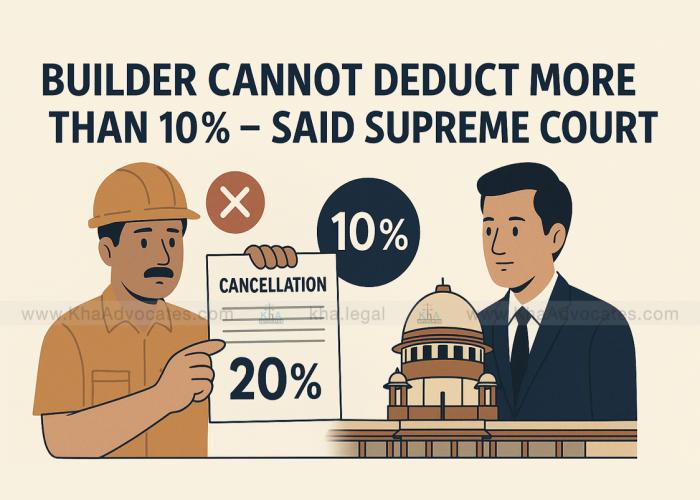
🏗️ IntroductionIn a landmark decision that strengthens consumer rights, the Supreme Court of India has ruled that builders cannot deduct more than 10% of the total flat cost when a buyer cancels the booking. The judgment comes as a relief to countless homebuyers who have faced unfair deductions from real estate developers during cancellations. This ruling sets a powerful precedent and aligns with the principles of fairness and reasonableness under Indian contract and consumer protection law.Background: Why This Issue MattersOver the years, many homebuyers have reported instances where real estate developers deducted 20%, 25%, or even 30% of the total property value when a buyer decided to cancel the booking, often without starting construction or incurring any loss.This unfair trade practice prompted legal intervention, and the judiciary has now taken a stand to protect buyers from arbitrary contract clauses that are heavily biased in favour of builders.Supreme Court Ruling: Key HighlightsIn the case of Wg. Cdr. Arifur Rahman Khan & Ors. v. DLF Southern Homes Pvt. Ltd., the Supreme Court upheld the consumer-friendly interpretation that if the builder has not incurred a substantial loss or started construction, they cannot deduct more than 10% of the booking amount or flat price.Important Takeaways:Maximum Deduction Limit: Builders can deduct no more than 10% in case of cancellation.Beyond 10% is arbitrary and amounts to unjust enrichment.Unilateral terms in builder-buyer agreements that allow excessive deductions are unconscionable and voidable.The builder cannot use delay tactics or unjust contract terms to deny fair refunds.⚖️ Legal Reasoning: Supreme Court’s AnalysisThe Court based its ruling on several legal principles:Principle of Unconscionable ContractsWhen one party (the builder) has excessive bargaining power, the Court can strike down oppressive terms.Citing Central Inland Water Transport Corporation v. Brojo Nath, the Court emphasized that contractual terms must be reasonable and fair.Consumer Protection ActThe Court reaffirmed that a buyer is a consumer and entitled to just treatment under Sections 2(1)(d) & 2(1)(r) of the Consumer Protection Act.Builders indulging in excessive deduction are guilty of unfair trade practices.Doctrine of ReasonablenessBuilders are not permitted to make windfall gains from cancellations.Refund policy must reflect actual losses, not speculative penalties.Other Important Judgments on the SubjectKailash Nath Associates v. DDA [(2015) 4 SCC 136]The Court held that forfeiture of earnest money is only valid if the party has suffered a loss. Builders must prove actual damage for withholding more than 10%.Haryana Urban Development Authority v. Dropadi DeviOnly reasonable forfeiture is allowed. Excessive deduction without justification is illegal.RERA Provisions – Section 18 of RERA Act, 2016The buyer is entitled to full refund with interest if the builder fails to deliver on time. Deductions exceeding 10% are in direct conflict with RERA’s spirit.What It Means for HomebuyersIf you have cancelled your flat booking and the builder is withholding more than 10%, you have a strong legal remedy. The following steps are advised:📋 What You Can Do:Send a legal notice seeking full refund minus 10%.File a complaint with the Real Estate Regulatory Authority (RERA).Approach Consumer Court if builder refuses or delays refund.Maintain booking receipts, payment records, and correspondence as evidence.Precautionary Measures for Future BuyersRead the Builder-Buyer Agreement thoroughly before signing.Negotiate clauses related to cancellation and refund.Prefer builders registered under RERA with transparent refund policies.Get legal vetting of the agreement from a property lawyer.How KHA Advocates Can HelpAt KHA Advocates, we assist homebuyers in fighting against builder malpractices, securing rightful refunds, and filing RERA and consumer complaints. Our team of real estate and litigation experts ensures your legal rights are protected.📞 Book a Consultation: https://khaadvocates.com/book-consultation🏢 Representing clients in Supreme Court, High Courts, RERA & Consumer ForumsConclusionThe Supreme Court’s ruling offers much-needed relief and clarity to homebuyers. By capping the builder’s deduction at 10%, the Court has reaffirmed the principle that contracts cannot override fairness and public interest. Homebuyers must remain informed, vigilant, and assertive in asserting their rights.
Read More
IntroductionSalt Lake City, officially known as Bidhannagar, was conceptualized and developed under the leadership of Dr. Bidhan Chandra Roy, the then Chief Minister of West Bengal. Conceived as a modern satellite township adjacent to Kolkata, the project involved the acquisition of wetlands and privately owned lands. These lands were subsequently allotted to individuals through lease agreements, each extending up to an unprecedented 999 years—ensuring government control while granting long-term occupancy rights.Initially, allotments were conducted through a lottery system. However, with time, the issue of property transfers within Salt Lake arose. The restrictive nature of lease deeds and the absence of a clear legal mechanism for transferring leasehold rights led many lessees to opt for unofficial means such as executing Powers of Attorney or Wills—resulting in a loss of revenue for the State.To address this issue and to establish legal clarity, the West Bengal government introduced a formal framework through a Gazette Notification in 2012. This article aims to provide a comprehensive and simplified explanation of the current legal position, procedures, and key judgments related to leasehold property transfers in Bidhannagar.Types of Lease Deeds in Salt LakeThe 17-Clause Lease DeedAmong the earliest lease agreements executed in the 1970s, the 17-Clause Lease Deed granted leaseholders more liberal terms, with no explicit restrictions on the transfer of property. Roughly 88 such deeds were issued to the first group of Salt Lake allottees.Due to the absence of any clause requiring government approval for transfer, leaseholders under this deed have historically enjoyed greater flexibility. Over the years, the Calcutta High Court has supported this interpretation, directing authorities to process mutations in favour of transferees without insisting on government permission.The 20-Clause Lease DeedUnlike the 17-Clause version, the 20-Clause Lease Deed contains specific restrictions that require prior approval from the Urban Development Department before any transfer of the leasehold property. These restrictive covenants are aimed at maintaining state oversight and regulating the sale of government-leased land.2012 Gazette Notification: Regulation of TransfersOn June 22, 2012, the West Bengal Government issued a Gazette Notification (No. 2709-SL(AL)/4S-9/2004(Pt-I)) introducing a formal transfer policy for leasehold plots in Bidhannagar. Key highlights include:Mandatory Government Approval: Transfer of leasehold rights requires prior permission from the Urban Development Department.Transfer Fee: A fee of ₹5,00,000 per cottah was introduced. However, exemptions apply for intra-family transfers (e.g., to parents or spouse).Regularization of Past Transfers: Past transactions conducted without government approval could be regularized upon payment of the transfer fee and completion of required formalities.Binding Lease Terms: All transfers are subject to the original lease terms, and the transferee inherits the obligations of the lease.This notification primarily targeted restrictive leasehold deeds (such as the 20-Clause Deed) but caused confusion regarding its applicability to 17-Clause Deeds.Landmark Judgment: State of West Bengal & Ors. vs. Ajay Poddar & Anr.This pivotal case resolved key ambiguities surrounding the 17-Clause Lease Deed. The issue before the Supreme Court was whether lessees holding 17-Clause Deeds could transfer their property without government approval or paying the transfer fee mandated in the 2012 notification.Supreme Court Ruling (March 11, 2015):The Apex Court ruled that the 17-Clause Deeds did not require government approval for transfers.The ₹5,00,000 per cottah transfer fee was deemed applicable only to restrictive lease deeds, such as those containing the 20 clauses.Past transfers executed without prior permission under 17-Clause Deeds were held valid, provided they complied with other legal requirements.Government agencies were directed to process mutations for such transfers without demanding approval or fees.This judgment provided significant relief to lessees and removed procedural bottlenecks for a large number of plot owners.2016 Circular: Simplification with ConditionsFollowing the Supreme Court judgment, the Urban Development Department issued Circular No. 693-UD/LM/SL(AL)-4S-5/2016 on May 4, 2016. This clarified the operational procedures for transferring 17-Clause Leasehold Plots:Prior Approval Not Required: Lessees need not seek permission from the government before transferring their plots.Mandatory Transfer Fee: Despite the removal of permission requirements, the transfer fee continues to apply—even for 17-Clause Deeds.Regularization of Past Transactions: Unauthorized transfers can be legalized upon payment of fees and proper documentation.This circular sought to balance ease of transactions with the state’s revenue interests and legal accountability.Step-by-Step Procedure to Buy Leasehold Plots in Salt Lake1. Document CollectionLease DeedAllotment LetterMutation Certificate (if applicable)Tax Clearance CertificateNo Objection Certificates (as applicable)2. Title Verification & Agreement PreparationConduct a thorough title search.Draft an “Agreement for Assignment of Lease” detailing sale price, terms, and responsibilities.3. Application for Transfer PermissionPrepare an application along with:Identity proof of buyer and sellerCertified copies of lease documentsAgreement for assignmentTax receipts and No Dues Certificate4. Online SubmissionRegister on the official portal of the Urban Development Authority.Upload notarized documents in PDF format (max 2MB each).Pay the application fee (currently ₹1,000).5. Verification ProcessAuthorities review documents and conduct physical inspection of the plot to match records.6. Hearing & Payment of Transfer FeeAttend the scheduled hearing with buyer, seller, and legal representatives.Pay the applicable transfer fee based on plot area.Submit draft deed for government approval.7. Deed RegistrationExecute and register the final Lease Transfer Deed at the designated registration office.The government issues a registration order upon approval.8. MutationSubmit the registered deed to the Urban Development Authority within 60 days.Apply for mutation to update ownership in official land records.Obtain a Mutation Certificate upon approval.ConclusionSalt Lake’s land transfer laws have evolved significantly since the township’s inception. The early liberal 17-Clause Lease Deeds offered flexibility, later reaffirmed by the Supreme Court, while the more regulated 20-Clause Deeds require strict compliance with transfer procedures.The 2012 notification and subsequent 2016 circular laid the groundwork for a structured and revenue-conscious framework. While these measures aimed to streamline transfers and reduce irregularities, practical challenges such as administrative delays and lack of public awareness continue to persist.Understanding the legal nuances and following proper procedures is crucial for any individual seeking to buy or transfer leasehold property in Bidhannagar. For smooth execution and legal compliance, it is strongly advised to consult experienced property lawyers familiar with Salt Lake’s unique lease framework.Need Legal Assistance for Salt Lake Property Transfers?At KHA ADVOCATES, our dedicated legal team provides expert assistance for lease deed reviews, mutation, registration, and title verification in Bidhannagar. Contact us today for a hassle-free consultation.📞 Call Now 94-777-5-888-5 | 🌐 Visit www.khaadvocates.comRelevant Links:Circular https://www.wburbanservices.gov.in/upload_file/circular/1721-ud.pdf2012 notification https://www.wburbanservices.gov.in/upload_file/file_doc/al_2709_3377.pdf88 Plots https://timesofindia.indiatimes.com/city/kolkata/salt-lake-plot-transfer-begins-again/articleshow/53470533.cms
Read More



When I was facing illegal harassment by an auto-rickshaw union and shameful inaction from Baguiati Police Station, I felt completely helpless. That’s when I found Mr. Kabir from KHA ADVOCATES, the best High Court lawyer for writ petitions. They didn’t just take my case — they fought for me with passion, skill, and fearless advocacy. Thanks to their hard-hitting arguments, we won the writ petition against the police department and the auto union. Justice was finally served! If you are searching for a powerful High Court advocate who will genuinely fight for your rights, look no further!
Kabir bhai was very courteous and provided a clear and precise review on the title search requirement. Also provided an honest guidance on the call. Highly recommended.
Kha Sir is the best lawyer who is so well knowledged & whenever we reach out to him he solve the problem within a day.We don't have to take any tension when Kha sir is there. Thank you so much Sir for all your guidance and advice.
Highly recommended for Divorce case. I got Divorce order so fast than my expectation. Thanks a lot Mr. Kabir

Could discuss my case in length. Useful advice was provided to me. I would like to recommend.

I have visited for NOC & declaration matter. Personally i think Mr. Kabir is very professional & very positive minded.
Very professional, on time and Technically good. We are extremely Satisfied with my apartment registration.
Excellent service, on time, technically efficient. We are very happy with the service provided. Thanks a lot.
Very loyal, I am very happy with his service, he is understanding, mature and very knowledgeable,any kind of problem he can solve
I was greatly relieved after talking to Advocate Kabir Hassan. I needed a clarification about the proceedings of my Talak with my current lawyer and Mr. Hassan confirmed with valid points. Thank you, again!
Very professional and very kind hearted person i have ever visited. Very helpfull in nature and one of the best lawyer's in my locality.
Very knowledgeable having a Positive Attitude towards client's problems, All the staffs are also helpful. Satisfied with their services.
It's an awasome place to resolved your legal issue...specially kabir sir is very good and honest person to solve your query step by step. Thanks to kha advocate for helping my legal issue..
One of the best experienced and professional advocate i have ever seen. Please do visit and consult with him. He is the best person to get rid you off from each and every law related problems.
it waa good experiance with KHA advocate for my hassle free registration. I highly recomend other to consult for any property related or legal matters with KHA thanks Anant Pradhan.
Having excellent analytical and logical approach is the hallmark in Law Firm. As per my convenience, I truly appreciate that KHA Sir take the time to talk to me. I express my gratitude to KHA for their help and support.
Very courteous, professional and competent law firm led by the able Mr. Kabir Hassan. They handled the searching, sale agreement / deed drafting, query generation / stamp duty payment and registration process of my new flat in New Town very, very smoothly despite several challenges / issues from the seller's end along the way.
Service provided by him was good. He is very polite, knowledgeable and helpful. He guided through our case very well.
Dive into our blog for the latest insights, tips, and trends. Stay informed and inspired by our expert articles on various topics that matter to you.
For Canadians holding an Overseas Citizen of India (OCI) card who want to invest in Indian real estate without physically travelling to India, the question is common:👉 Can you buy property through a Power of Attorney (POA)?👉 What is the exact lawful process?👉 What are the required documents, legal risks, and government rules?This guide answers these questions in simple language — but with professional legal precision — so you and your family can make informed, compliant investment decisions in Indian property law.Can an OCI Card Holder Buy Property in India Without Coming to India?Yes — Generally, YesAs per Indian law under the Foreign Exchange Management Act (FEMA) and its Rules (especially Foreign Exchange Management (Non-Debt Instruments) Rules, 2019), an OCI card holder is legally allowed to:✅ Purchase residential & commercial property in India❌ Except agricultural land, plantation property, or farmhouses (unless inherited) Under FEMA Section 5 & Section 46, OCIs enjoy general permission to acquire immovable property without prior approval of the Reserve Bank of India (RBI), provided all payments are made through permissible banking channels. 📌 Important Legal Foundation📜 1. FEMA 1999 & Non-Debt Instruments RulesContains the core rules on foreign acquisition and transfer of immovable property.OCIs fall under the permitted class (similar to Non-Resident Indians (NRIs)).Purchase of residential or commercial property requires no RBI approval; agricultural-related property does. 📜 2. Transfer of Property Act, 1882Governs how property rights can be transferred through sale deeds, wills, or POA.Under Section 5 & Section 54 (Definitions) it recognises valid conveyance through registered instruments. 📜 3. Indian Registration Act, 1908All instruments dealing with immovable property (including sale deeds and POA) must be registered at the local Sub-Registrar’s office for legal effect.Notarised but unregistered POA is legally ineffective as a transfer instrument. Can a POA Be Used to Buy Property Without Physical Presence?Yes — But Only If Done Correctly.A Power of Attorney allows your appointed representative in India to act on your behalf for specific property dealings including:➡ Identifying property➡ Negotiating price➡ Signing the sale agreement➡ Executing the sale deed➡ Attending registration formalitiesBut there are legal requirements:1️⃣ Special/Specific Power of Attorney (SPA)a. Must be carefully drafted to clearly list powers — e.g., negotiation, signing agreements, registration, tax payments.b. A general POA is insufficient for property purchase. 2️⃣ Attestation/ApostilleIf executed outside India, the POA must be:a. Notarised in Canada (or local state)b. Then either:✔ Apostilled (if Canada is Hague member), or✔ Attested by the Indian Consulate/EmbassyThis ensures Indian authorities accept it as authentic. 3️⃣ Registration in IndiaThe POA must be:📍 Registered with the Sub-Registrar Office where the property is located📍 Paid applicable stamp duty (state-specific)Note: A notarised POA alone — without registration — is not legally effective to deal with property. 🧭 Step-by-Step Process to Buy Property via POA (Canadian OCI)This process helps you purchase legally and securely without traveling:🔎 Step 1: Identify the Propertya. Confirm seller’s titleb. Conduct title and encumbrance searchc. Ensure no litigation or fraud history‼ This is where legal due diligence done by an expert law firm like KHA Advocates protects you.🖋️ Step 2: Draft and Execute Power of AttorneyYour Canadian OCI must:✔ Choose the attorney (trustworthy person in India)✔ Draft a specific SPA✔ Notarise it in Canada (state)✔ Apostille/Consulate attestation✔ Ship properly sealed to India✔ Get it registered locally with stamp duty paid📌 POA must be time-bound, specific & covers registration authority.💸 Step 3: Arrange FEMA-Compliant PaymentPayment for property must follow FEMA guidelines:✅ Through inward remittanceOR✅ From your NRE, NRO, or FCNR(B) account❌ Cash/Foreign currency notes/Traveler’s cheques NOT ALLOWED. 📄 Step 4: Sale Agreement & RegistrationYour attorney will:1. Sign the Agreement to Sell2. Pay earnest deposit3. Prepare the Sale Deed4. Pay stamp duty & registration fees5. Register the sale deed at Sub-Registrar’s OfficeOnly a registered Sale Deed transfers ownership. — POA itself does not transfer rights legally. 🧾 Step 5: PAN & Tax ComplianceOCI must hold:✔ Indian PAN Card (Income Tax purpose)✔ Comply with TDS requirements (if applicable)✔ File Income Tax return if rental income earnedPAN is essential for registration and taxation. 🏦 Step 6: Repatriation of Sale Proceeds (Future)If the OCI sells later and wants to bring money abroad:✔ Repatriation of sale proceeds is allowed subject to RBI rules and compliance with FEMA and tax laws.📌 Common Legal Pitfalls to Avoid❌ Using a Notarised POA only without registration❌ Ambiguous or blank powers❌ POA not consulate-attested or apostilled❌ Missing PAN or TDS compliance❌ Paying outside permissible channelsYes — a Canadian OCI card holder can legally buy residential or commercial property in India without coming to the country, provided all legal formalities are followed, especially through a registered Power of Attorney and FEMA-compliant payment methods.This method is entirely lawful and widely used, but depends heavily on:✔ Properly drafted, attested & registered POA✔ Clear title & due diligence✔ RBI/FEMA compliance✔ Local Registration complianceWhy Choose KHA Advocates?We specialize in:✔ OCI & NRI Property Transactions✔ Power of Attorney Drafting & Registration✔ FEMA & RBI Compliance✔ Property Title Verification✔ Sale Deed Registration Support✔ Cross-Border Real Estate AdvisoryWe assist clients globally — including Canada, USA, UK, Australia & Middle East.Contact Details :KHA Advocates [Law Firm]Google Location : https://share.google/oFGKBu7PpPPNJalp0 New Town, Hatiara, Dhankal, Noapara, Kolkata, West Bengal 700157📞 Phone: +91-94-777-5-888-5📱 WhatsApp: +91-8010-555-666📧 Email: contact@khaadvocates.in🌐 Website: https://www.khaadvocates.com 🗓 Book Consultation: 👉 https://khaadvocates.com/book-consultation
Read More
Taking out a loan is common in today’s India — whether for education, business, a home or vehicle. But what happens if you default or fall behind on repayments? While banks and lending institutions are legally entitled to recover dues, there’s a clear line between lawful recovery and harassment. This blog explains your rights as a borrower, what the regulatory and judicial safeguards are under the Reserve Bank of India (RBI) and the Supreme Court of India, how defaults affect your credit (for example via TransUnion CIBIL Limited), and how a lawyer specialising in borrower-protection can help you navigate recovery, negotiate with lenders and stop unfair practices.Why this mattersMany borrowers panic when they are contacted by recovery agents or notices arrive. They may feel powerless. But the truth is: you do have rights. And knowing those rights — plus having a strategy for communication, restructuring or settlement — can make a big difference. It’s not just about avoiding trouble, it’s about protecting your dignity, your credit record and your future borrowing capacity.1. What is lawful loan recovery — and what counts as harassment?Lawful recoveryWhen a borrower defaults, banks and NBFCs have the legal right to recover the money secured under contract. This may include: sending notices, calling you, eventually enforcing security (for secured loans) via laws such as the Securitisation and Reconstruction of Financial Assets and Enforcement of Security Interest Act, 2002 (SARFAESI Act) if applicable. For unsecured loans, the lender may initiate civil legal action or arbitration.What amounts to harassment?Harassment arises when recovery steps go beyond legal, ethical and regulatory boundaries. Some examples of prohibited practices under RBI guidelines and court judgments include:Persistent phone calls or visits at odd hours (e.g., before 8 a.m. or after 7 p.m.), or on Sundays/holidays, without your consent. Use of threats, intimidation, muscle power, public shaming or humiliation. Disclosure of your loan default status to your friends, neighbours, colleagues or employer without your consent — thereby breaching your right to privacy and dignity. Visiting your workplace or home unannounced and cut off from the recovery process’s due course. Taking possession of assets without following the statutory steps, or seeking to coerce you into a settlement under threat.In effect: banks & their agents may collect dues, but they must treat the borrower with dignity and follow due process. The RBI’s Fair Practices Code and circulars make this clear. 2. Key regulatory & judicial protections: RBI + Supreme Court guidelinesRBI guidelinesUnder the Fair Practices Code for Lenders and the related Master Circulars, the RBI has advised banks: “in the matter of recovery of loans, the lenders should not resort to undue harassment viz. persistently bothering the borrowers at odd hours, use of muscle power for recovery of loans, etc.” On 12 August 2022, the RBI issued guidelines on outsourcing of financial services (including recovery agents) that stipulate regulated entities (REs) must ensure their agents do not resort to intimidation or harassment of any kind. Recovery agents are typically allowed to contact borrowers only in defined time slots (in many sources 8 a.m. to 7 p.m.) unless otherwise agreed; they must carry ID cards and have an authorisation letter from the bank. Supreme Court / Legal rulingsThe landmark case ICICI Bank Ltd. v. Shanti Devi Sharma (2008) [2008 7 SCC 532] held that banks cannot adopt strong-arm tactics or employ ‘muscle‐men’ for recovery; they must resort to lawful processes for enforcement of security/loan dues. Courts have repeatedly held that the bank is vicariously responsible for the actions of its recovery agents; unlawful acts by agents can attract regulatory and criminal liability. What this means for a borrowerIf you are being harassed by calls outside permitted hours, or by agents using intimidation, you have a remedy.You can approach the bank’s grievance cell, the Banking Ombudsman under the RBI’s scheme, and ultimately consumer forums or courts for relief. Banks failing to adhere can face regulatory actions by the RBI and compensation orders via Ombudsman. 3. The downside: CIBIL / credit bureau impact & longer-term risksEven if you are correct and not being harassed, a default on loan repayments has implications:Your credit score monitored by CIBIL (or other credit bureaus) can drop. Defaults, non-performing assets (NPAs) and settlements reflect in your credit history.If you settle for a lesser amount (one-time settlement) your record may get a “Settled” or “Closed” tag rather than “Paid in full”, which may affect future loan or credit card approvals.Follow-up harassment or asset‐seizure threats are often triggered not because the bank is “mean” — but because they want to recover before the loan becomes an irrecoverable NPA. Early action helps you negotiate better.Lack of awareness can lead to signing away rights or accepting unfavourable terms under pressure, leading to loss of assets or worse credit consequences.So, while you must protect your rights, you should also take a proactive stance: engage with your lender, seek restructuring, negotiate settlement options, and ensure your credit protein stays intact.4. Practical strategies for borrowers – what you should doa) Stay calm and proactive.Don’t ignore default. The earlier you engage the lender, the more options. Contact your loan officer or branch manager, explain your cash-flow issue, and seek a restructure or moratorium if available.b) Document everything.Save messages, call logs, emails from the bank/recovery agent.If a recovery agent visits your home or workplace, record the date, time, their ID, authorisation letter.If the caller is abusive or calls at odd hours, note it down with screenshots or recordings. This becomes evidence if you later file a complaint or legal action.c) Know your rights and set boundaries.You may set and communicate convenient time slots for calls (within 8 a.m.–7 p.m.) and inform the bank in writing.If agents visit without notice or outside reasonable hours, you can object and register a complaint.You can ask for a written representation of the outstanding, ask for settlement/OTS offers, ask for loan restructure options.d) Negotiate settlement or restructure.If your earnings or business situation is disrupted, ask the bank for a one-time settlement (OTS) or restructuring of loan (change term, interest rate, moratorium etc.). A lawyer can help you negotiate favourable terms and draft formal letters to the bank so that the process is transparent.e) Escalate when needed.If bank doesn’t respond to your grievance, approach the Banking Ombudsman via the RBI’s portal.If agents use threats or force, file a police FIR under relevant IPC provisions (for example, criminal intimidation, trespass). In case of major unfair practice, approach consumer court for compensation and injunction against the bank/agent.f) Protect your credit record.Ask the bank to update your account status after settlement. If you are caught unaware, your account might be closed as “Written-off/Settled” which could hamper future loans. Keep CIBIL (or other bureau) updates in mind.5. Role of a lawyer – how legal help enhances your protectionWhen dealings get complicated, you’ll benefit from the assistance of an experienced lawyer – especially one specialising in borrower-rights, bank recovery and consumer protection. Here’s what a lawyer can bring to the table:– Legal assessmentA lawyer will review your loan contract, check whether the lender/recovery agent is following due process, and identify if you have been subjected to unlawful recovery practices or harassment.– Drafting legal notices & lettersRather than informal calls, a lawyer can send a legal notice to the bank or recovery agent outlining violations (harassment, call timings, privacy breach) and calling for redress. This often triggers faster settlement / restructuring offers from the lender.– Negotiation & settlement supportLawyers can negotiate with banks for one‐time settlement, drop or reduce interest/penalties, get formal written confirmation of settlement terms, and ensure that the settlement doesn’t adversely affect your credit history unduly.– Filing complaints & litigationIf harassment continues, the lawyer can guide you in filing a complaint under the Banking Ombudsman Scheme, consumer forum petition or civil suit for damages. They can also help file FIRs where criminal intimidation is involved.– Credit report/correction supportAfter settlement or restructuring, the lawyer can ensure that the lender updates the credit bureau appropriately, and can help in raising disputes/corrections with CIBIL or other agencies if your status is improperly reflected.– Asset-seizure defenceIn the case of secured loans where banks threaten to seize collateral (under SARFAESI or otherwise), a lawyer can challenge unlawful possession, check compliance with notice periods (like 60 days under SARFAESI), represent before DRTs (Debt Recovery Tribunal) and safeguard your property rights. In short: a lawyer adds both a legal shield and a negotiation advantage.6. Summarised checklist for borrowers✅ StepWhat to doWhy it matters1. Understand your loanKnow your EMI amount, interest rate, security (if any), default statusHelps you engage knowledgeably2. Engage the lender earlyContact bank, ask for restructuring, settlement optionsEarly engagement tends to yield better outcomes3. Document all interactionsKeep call logs, agent visits, written communicationEvidence is key if things go wrong4. Check recovery agent conductAre calls between 8 a.m.–7 p.m.? Do they carry ID? Are they avoiding threats?Breach means you can complain5. Know your rightsNo intimidation, no public shaming, privacy must be protectedProtects your dignity, future borrowing6. Approach lawyer when neededGet professional support to negotiate / defend your rightsSignificantly improves negotiating power7. Monitor your credit reportAfter settlement/restructure, check CIBIL or other bureau for correct statusEnsures future loan access is not harmed7. In conclusion: You are not powerlessYes — banks and NBFCs have the right to recover loans. But they cannot disregard your rights. The RBI and Supreme Court guidelines make it clear: recovery must be lawful, respectful, transparent and conducted with dignity. If you face harassment, you have legal recourse. Simultaneously, you must proactively engage with the lender, consider practical solutions like restructuring or one-time settlement, and monitor your credit health. A lawyer who understands borrower-rights can be the difference between being pushed into a disadvantageous settlement and negotiating a workable, dignified outcome.If you’re facing persistent calls, threats or unfair recovery tactics — remember: this is not just stress or part of default. It may be a violation. Document it, engage your bank, and if it continues, seek legal help. Your rights are protected. Your credit and dignity matter.8. When Should You Contact a Lawyer?Reach out to a legal professional if:You’re receiving threat calls or late-night messages.Recovery agents visit your home or workplace repeatedly.You’ve been humiliated publicly or online by agents.You want to negotiate settlement legally to protect your CIBIL score.You’ve received a SARFAESI notice or legal summons.Early legal help prevents escalation and ensures your rights are respected from day one.9. How KHA Advocates Protect BorrowersAt KHA Advocates, we understand that loan recovery disputes can cause stress, confusion, and fear. Our legal team specialises in banking law, borrower protection, and debt resolution strategies.🌐 Our Services Include:Drafting & sending legal notices against recovery harassmentNegotiating loan settlements & restructuring dealsHandling RBI Ombudsman & Consumer Forum casesDefending SARFAESI & DRT matters to protect your propertyHelping update CIBIL / credit bureau records post-settlementOffering confidential consultations for borrowers under pressureEvery case is handled with utmost discretion and legal precision. We aim not only to protect your rights — but to restore your peace of mind and financial dignity.📞 Contact KHA AdvocatesKHA Advocates – Legal Experts in Borrower Protection & Banking Laws📍 Office: New Town, Kolkata 700157📧 Email: contact@khaadvocates.in📱 Phone: +91-9477758885📱 WhatsApp: +91-8101-555-666🌐 Website: www.khaadvocates.com💬 “Legal strength, strategic negotiation, and borrower dignity — that’s what we stand for.”9. Final TakeawayBanks have the right to recover loans — but not the right to harass you.Borrowers have legal protection under RBI & Supreme Court guidelines.If you’re facing unfair recovery practices, remember:You can say no to intimidation.You can complain and take legal action.You can restructure or settle smartly — with the right legal guidance.Whether you need advice, negotiation, or defence — KHA Advocates stands with you.Because every borrower deserves respect, fairness, and lawful recovery.
Read More
IntroductionBuying your dream home is one of the biggest financial and emotional decisions of life. Many buyers, especially first-time buyers, are drawn towards under-construction flats or apartments because they are often cheaper than ready-to-move-in properties and come with flexible payment options. However, under-construction properties also involve higher risks, such as project delays, legal disputes, or even fraud.As a buyer, knowing the legal process, safety measures, and essential do’s & don’ts can help you secure your investment and avoid unnecessary stress.At KHA Advocates, we assist property buyers with end-to-end legal support, from due diligence to registration, ensuring you buy your home with complete confidence.Step-by-Step Legal Process of Buying an Under-Construction Flat1. Check RERA RegistrationVisit your state’s RERA (Real Estate Regulatory Authority) portal.Verify whether the project is registered.Check the builder’s past projects, timelines, and compliance status.👉 Why it matters: Only RERA-approved projects provide legal safeguards for buyers.2. Verify Builder’s Title & ApprovalsConfirm the builder has clear ownership or development rights over the land.Check approvals from local authorities (municipality, fire, environmental clearance, etc.).👉 Why it matters: Buying from a builder without proper approvals can lead to cancellation of the project.3. Examine the Builder-Buyer AgreementCarefully review clauses on possession date, construction linked payments, cancellation, and refund policies.Look for hidden charges (maintenance, parking, club membership, etc.).👉 Why it matters: This agreement defines your rights – a lawyer can help negotiate unfavorable terms.4. Payment & Home Loan ProcedurePayments should follow the construction-linked plan and not exceed 10% before agreement registration (as per RERA).For home loans, banks conduct their due diligence – but don’t rely solely on bank approvals.5. Registration of Agreement for SaleLegally register your agreement at the Sub-Registrar’s office.Pay applicable stamp duty & registration charges.6. Possession & Occupancy CertificateBefore possession, check for Occupancy Certificate (OC) and Completion Certificate (CC).Without these, the property is legally incomplete.Safety Measures Before Booking an Under-Construction Flat✅ Check Builder’s Reputation – Past delays, litigation, financial standing.✅ Verify Carpet Area – RERA mandates selling on carpet area, not super built-up.✅ Escrow Account Compliance – Ensure builder deposits 70% of buyer’s funds in RERA account.✅ Timely Updates – RERA requires builders to provide construction progress updates online.✅ Legal Scrutiny of All Documents – Hire a property lawyer to verify every paper.Do’s & Don’ts List for Buyers✅ Do’s:Do verify the project’s RERA registration.Do conduct a legal title check of the land.Do hire a real estate lawyer for document vetting.Do keep all receipts, agreements, and builder communication in writing.Do check for hidden charges like GST, maintenance, parking.❌ Don’ts:Don’t rely solely on the builder’s brochure or promises.Don’t pay more than 10% of the cost before agreement registration.Don’t skip checking OC & CC before taking possession.Don’t ignore the fine print in the builder-buyer agreement.Don’t book based only on verbal assurances or flashy advertisements.Case Study: Buyers Saved by Legal Due DiligenceA group of buyers in Kolkata booked flats in an under-construction project that was heavily advertised. Our team at KHA Advocates was approached for due diligence. Upon inspection, we found that:The land title had a pending litigation.The builder had failed to secure environmental clearance.By acting early, the buyers avoided investing in a risky project and redirected their funds into a RERA-compliant development.👉 Lesson: A small investment in legal checks can save you from losing your life savings.Why You Need a Real Estate Lawyer for Under-Construction PropertiesContract Protection – Lawyers help negotiate builder-buyer agreements to protect your interests.Fraud Prevention – Prevents scams by verifying builder credentials and land titles.Compliance Checks – Ensures approvals and sanctions are in place.Dispute Resolution – Quick legal recourse in case of delays or defaults.Peace of Mind – Focus on your dream home while your lawyer safeguards your investment.ConclusionBuying an under-construction flat can be rewarding, but it comes with risks that only expert legal guidance can minimize. Don’t let hidden clauses, delayed possession, or fraud turn your dream home into a nightmare.At KHA Advocates, we specialize in property law and real estate legal services. From document verification to dispute resolution, we ensure that your home-buying journey is secure, transparent, and stress-free.👉 Build your dream home with confidence – Partner with KHA Advocates today!📞 Contact Us: +91-9477758885📧 Email: contact@khaadvocates.in📍 Location: New Town, Near CC2, Kolkata, West Bengal, India🌐 Visit: www.khaadvocates.com
Read More
KhA Advocates is a premier law firm in Kolkata, West Bengal known Internationally, providing expert legal services in property registration, corporate law, matrimonial law, taxation, dispute resolution, and more. We offer tailored legal solutions for NRIs, businesses, and residents, ensuring 100% compliance and protection. With our efficient, transparent, and reliable approach, we safeguard your legal interests.
.jpeg)

.jpeg)















One of the best experienced and professional advocate i have ever seen. Please do visit and consult with him. He is the best person to get rid you off from each and every law related problems.
Kaushuk Das